
SEE WHAT'S NEW IN THE DOOR WORLD
Newest Story

This 54-foot by 17-foot Schweiss lift strap bifold door traveled 7,445 miles over land and sea to reach its destination at Yap International Airport...
Continue to Full Story
Most Popular Story

Local zoning ordinance prevented Herb Korthuis from building a garage door taller than 8 feet. It was Schweiss to the rescue with a 16 ft. tall bifold door...
Continue to Full Story
Random Story

Veterinary surgeon Robert Moore's passion true lies in cars, choosing to store them in his 50' x 55' car barn fitted with 30' x 10'...
Continue to Full Story
Random Story
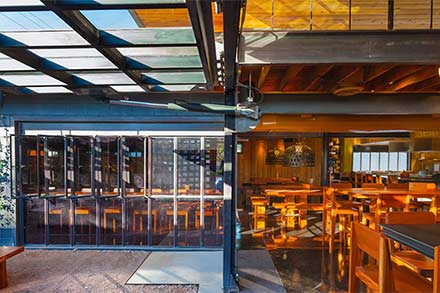
Traditional Thai food has a reputation of being very spicy and hot enough to satisfy anyones taste for heat. A newly opened...
Continue to Full Story
Golden 1 Center

The $507 million Golden 1 Center is a multi-purpose indoor arena also known as the Sacramento Kings Stadium, in downtown Sacramento, CA...
Continue to Full Story
Barrel & Bushel
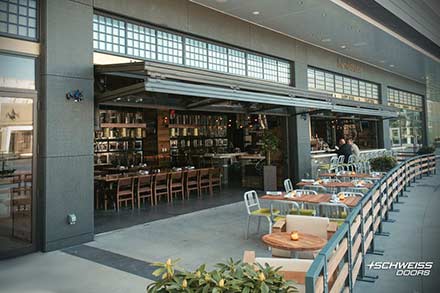
When Barrel & Bushel, a new beer-centric restau-rant at Tysons Corner, Virginia says "Handcrafted Just for You," they are referring to more than...
Continue to Full Story
Silicon Valley Home
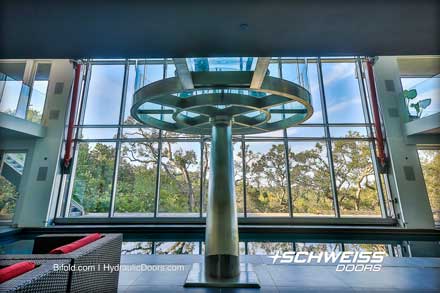
This ultra-contemporary California project, the creation of the award-winning architectural firm of M•Designs Architects and a Silicon Valley...
Continue to Full Story
Schweiss Origins

Mike Schweiss is one focused individual. Rather than devoting time and energy to a wide variety of activities and undertakings - doors and horses...
Continue to Full Story
Bobby Hotel Bus
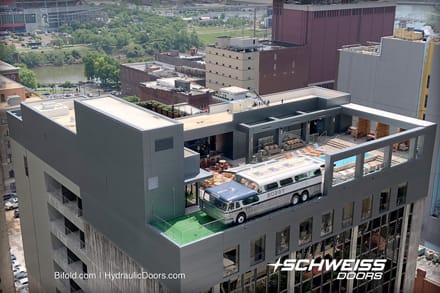
The renovated Bobby Hotel in downtown Nashville, Tenn. has a unique landmark, a 1956 Greyhound Scenicruiser bus hoisted 10 stories up on its roof....
Continue to Full Story
Carriage House
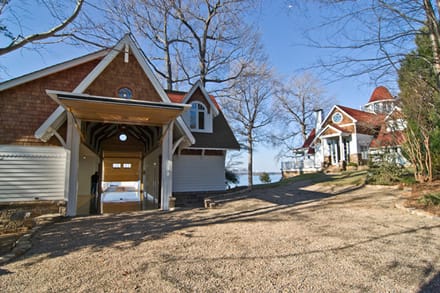
The Carriage House on the lakeshore property near Cornelius, NC is very likely the most unique in America with two Schweiss hydraulic doors!
Continue to Full Story
SEE WHAT'S NEW IN THE DOOR WORLD
We invite you to visit our "Must See Photos" section on our website. It's the home of great photos, stories and offers a real service for people looking for unique ideas for hydraulic and bifold liftstrap doors. You'll see residential, commercial, agricultural, aviation, industrial and designer doors of all types and styles. Read why these Schweiss Doors customers are 100 percent satisfied and in some cases what they did to give their buildings a special flair.

|
Schweiss Door Journeys 7,445 Miles Across Land and Sea to Support Missionary Efforts
This 54-foot by 17-foot Schweiss lift strap bifold door traveled 7,445 miles over land and sea to reach its destination at Yap International Airport on Yap Island, located in the far western Pacific Ocean. The door was installed on a newly renovated hangar owned by Pacific Mission Aviation, a Christian missionary organization that uses its fleet to respond to emergencies on the island, provides free medivac flights for those living on the surrounding islands, and much more. PMA painted, welded together, and installed the door themselves over the course of a few months when they had spare time. |

|
From Damage to Defense: Portland's Courthouse Reinforced with Schweiss Security Doors
Hatfield Courthouse in Portland ordered 7 Schweiss bifold security doors to prevent forced entry after experiencing a lot of damage during the civil unrest in the spring of 2020. The doors had to pass extensive testing, including three 30-minute forced entry tests and a one hour long simulated break-in. These are no ordinary doors - just one of these doors weighs as much as other Schweiss Doors four times its size! Safety features of the doors include top override switches, electric photo eye sensors, warning lights and horns and emergency back-up hand cranks in case the power goes out. |

|
“Psycho's” Hangar: A Pilot's Passion for Perfection
“Psycho” Mike McLeod discovered hydraulic doors via Schweiss Doors while researching other door types for his new hangar - eventually deciding to order one! Mike has been a devoted aviation ethusiast his entire life, so when his old Navy buddies asked if he was buying an airplane after he built his RC plane model shop - it hit him. He adjusted his plans for the shop to become a full multipurpose hangar, now including a private airfield. Focusing on maintainability and repairability, Mike ordered a 30ft x 11ft Schweiss hydraulic door with the complete Schweiss weather seal kit. |

|
A farmer's wish for larger shed doors granted thanks to Schweiss Doors' bifold doors
Mark Johnson was so happy with the Schweiss bifold door installed on his newer shed that he ordered another to put on an existing shed on his farm. Both of his doors are clad in a cream steel sheeting to match the buildings they were installed on. The newer door also has a dark brown wainscoting added to match the newer building. Mark was tired of dealing with little doors getting in the way of moving equipment, so he knew he wanted a big door for the new shed. The new shed has a 40 ft. Schweiss bifold lift-strap door and the existing shed now has a 24 ft. Schweiss bifold lift-strap door. |

|
Burmese teak cladding gives California hydraulic garage door class
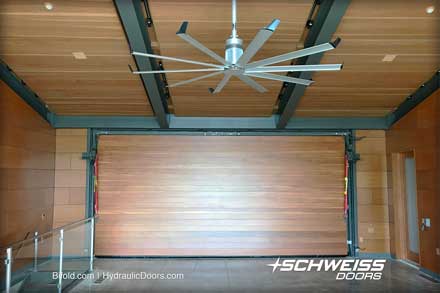
This 30 ft x 8.9 ft Schweiss hydraulic door in Brentwood, California was cladded with beautiful FEQ Burmese teak wood known for its lovely golden brown color. The 2.5 in. thick teak cladding on the outside and a high-end 3/8 in. birch plywood and cedar liner on the inside added an additional weight exceeding 1,050 lbs., requiring a strong source of power to lift it - the powerful Schweiss hydraulic cylinders and Red Power pump easily lift and lower the door quickly, quietly and safely. The door also included photo eye sensors and remote openers. The customer couldn't be happier! |

|
The Future of Flexible Spaces: Schweiss Doors Transforms The University of Arizona's Health & Sciences Innovation Atrium!
Three glass Schweiss hydraulic doors were used on the University of Arizona's Health & Sciences Innovation building. The 26ft wide x 21ft tall doors allow in plenty of natural light and create an indoor/outdoor space that helps provide an atmosphere of inclusiveness, aiming to attract the community to engage, interact, and foster connections - a priority of the University of Arizona. Each door is equipped with photo eye sensors and micro switches to ensure safe operation. |

|
Farm Innovations: The Role of Schweiss Doors in Agricultural Operations!
First-time Schweiss Door owner Nick Welu ordered a 30 ft. x 18 ft. Schweiss bifold door for the new machine shed on his farm to store equipment. He was very happy with the process, believing Schweiss surpassed all his expectations! Nick first encountered Schweiss sometime in the late 60s, when Schweiss was manufacturing chicken pluckers and hog crates. When Schweiss started manufacturing doors, Nick became curious to learn more about it and was specifically intrigued by the lift strap technology. Nick's door is fitted with lift straps and was ordered with the complete weather seal kit to help keep the machine shed weather resistant. The door is cladded in steel sheeting with dark green wainscoting. |

|
Hangar Home Living: Fly in, Fly out in Harmony with Schweiss Doors!
A lot at Stellar Airpark Estate in Chandler, Arizona features a newly built hangar home that is fitted with a Schweiss bifold lift strap door. The large door is 60-foot wide by 17-foot tall and operates using advanced lift straps developed by Schweiss Doors in the early 90s. The Schweiss door also features an internal truss, giving the door extra support while preserving a sleek, minimalist design to continue the clean and luxurious theme of the property. It is also equipped with an additional jiggle switch to act as a backup for the standard limit switches that come with every standard Schweiss door. |

|
Ohio River Home: Where Functionality Meets Elegance with Schweiss Doors!
Brad & Jenny are proud of owners of two wonderful buildings, their hangar and their new home. Both buildings are fitted with Schweiss Doors. Their unique five-sided hangar is fitted with two Schweiss bifold liftstrap doors. The larger door on the front of the building is 75ft wide by 18ft tall and the smaller door on the back of the building is 50ft wide by 16 ft tall. A few years after building their hangar, they constructed their new home which sports a Schweiss hydraulic door on the garage. The hydraulic door measures 27ft wide by 8ft tall and is equipped with a battery backup. |

|
Schweiss Doors Crafts Luxury in Puerto Rico Paradise!
Three Schweiss bifold lift strap doors were sent to Dorado, Puerto Rico to be used as garage doors on a stunning luxurious home. All three doors were equipped with photo eye sensors and door base safety edges to ensure the safest operation for residential use. Two of the three bifold garage doors span a width of 8 feet and stand 7 feet tall, while the large central door measures an impressive 18 feet wide and 7 feet tall. The three Schweiss bifold lift strap doors enhance the aesthetic appeal of the home but also provide a seamless and convenient lifestyle for those residing within it. |

|
Schweiss Doors makes history with largest hydraulic door on world's first net zero airplane hangar
Schweiss Doors has once again made history, manufacturing their largest hydraulic door to date for a net-zero hangar in Concord, New Hampshire. The hangar features two Schweiss hydraulic doors, the smaller measuring 50ft wide by 27ft tall. The larger door is the largest hydraulic door Schweiss has manufactured, measuring a tremendous 120ft wide by 27ft tall. The hangar is used by United Therapeutics to store some captivating aircraft and is the world's first net-zero wood truss hangar, built by Silver Maple Construction. The Schweiss hydraulic doors were erected by Irishspan Industries. |

|
Tallahassee Countryside Car Barn Chose Schweiss Doors!
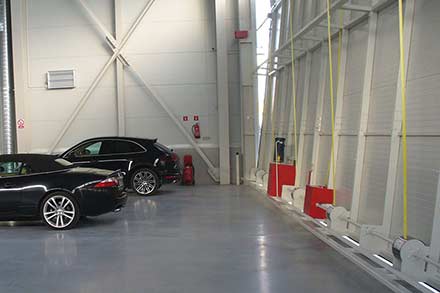
Veterinary surgeon Robert Moore's passion true lies in cars, choosing to store them in his 50' x 55' car barn fitted with 30' x 10' Schweiss hydraulic door. Moore, located in Florida, wanted a tightly sealed door to prevent bugs and heat from getting into the building, which he's happy to say the Schweiss door has done exactly that. He used to have to cover his cars when he's away for work because of the bugs getting into his old building, but now he says he hasn't seen a single bug on the floor when he returns. Because of the strong seal on the door, Moore also says he hasn't had to touch the thermostat. |

|
British Columbia hangar matches the beauty of nearby Kootenays
Rob McLeod, a veterinarian of Creston, British Columbia, should be pretty proud of his 44' x 30' hangar. It is fitted with a Schweiss bifold door and closely matches his home and other buildings on the property with the help of the Douglas Fir log posts, beams, and window accents. The Schweiss Door is 42.6' x 12.6' and is equipped with an automatic latching system, remote openers, and three large 3' x 6' windows. From Spring to Fall, Rob parks his Maule M-5-210C inside the hangar, the plane he uses to bring veterinary animal care to remote clients as a sort of air ambulance. |

|
Giving Wings To Dreams . . . Mike Schweiss inducted into Aviation Hall of Fame
Mike Schweiss, founder of Schweiss Doors in Hector, Minnesota, was honored by being inducted into the Minnesota Aviation Hall of Fame as a member of the Class of 2024. Mike started by inventing various agricultural-related manufacturing projects such as farrowing crates and the well-known Chicken Plucker before eventually moving on to doors, first starting with bifold doors and then adding one-piece hydraulic doors a few years later. Over the years, Mike continued to make significant improvements on his design, most notably the advent of the patented liftstrap bifold door. |
|
Canadian Recycling and Waste Centre focuses on customer convenience with a Schweiss bifold liftstrap door
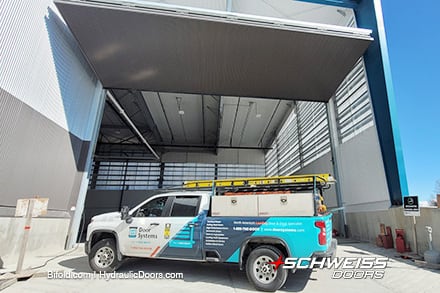
The new Surrey, Canada Recycling and Waste centre in British Columbia is opening its Schweiss 38.7 ft. x 30 ft. bifold liftstrap door to the public for easy disposal and recycling and waste products. The new recycling and waste centre is open seven days a week, 363 days a year as a convenient drop-off location for residents and businesses. The door was installed by Door Systems and headed by Matt Faupel. Faupel was recently named International Door Tech of the Year in 2021 and says he considers Schweiss Doors to be top of the line. |

|
Retired airline pilot is sold on safety of Schweiss bifold liftstrap doors
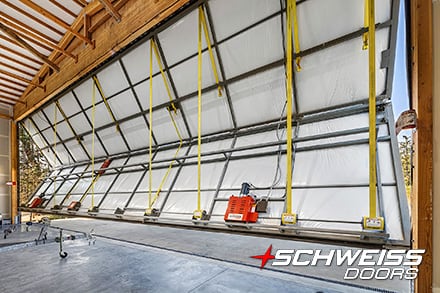
Ray Cook is a retired American Airlines pilot of 40 years. He has Schweiss bifold liftstrap doors on both of his hangars - one for winter and one for summer! The first hangar is in Spring Grove, Illinois where he spends his summer; The newest door is on his hangar in Lake Placid, Florida where he spends his winter! Cook's first hangar originally had a cable bifold door and it came tumbling down hard, so he replaced it with a new bifold liftstrap door. If you ask him what he thinks about cable lift doors now, he'll tell you that he would never have another one. The lift straps are much better. |
|
Hangar at scenic Roche Harbor, WA gets fitted with 60 ft. Schweiss bifold door
This 65 ft. x 60 ft. private residential hangar in Roche Harbor, WA was recently fitted with a 60 ft. x 18 ft. Schweiss bifold lifstrap door. The hangar is also equipped with the Schweiss automatic arm latch system and is large enough to hold several aircraft. The owner of the hangar said that most of the bigger hangars around Roche Harbor also have Schweiss Doors. Roche Harbor is a historic seaside resort island located on San Juan Island, Washington with many tourist lodging options: luxurious modern homes, fishing and whale watching charters, historic hotels and quaint residential cottages. |

|
Lifelong Pilot Makes a Hangar Upgrade He Will Never Regret
Mike Larson chose Schweiss to convert his cable bifold doors into strap bifold doors - he claims it was the best upgrade to their hangar yet! Mike and his wife, Charmian, first learned of Schweiss when they saw the straps in Oshkosh, WI at EAA AirVenture - the largest fly-in convention in the world. They considered replacing their doors, but decided the Schweiss liftstraps were sufficient. The liftstraps are only one of many upgrades the Larsons have done on their hangar over the thirteen years they've lived at their current residence, including a second door, automatic latches, and remote openers. |
|
Function and aesthetics of Boston area home are enhanced by innovative Schweiss hydraulic door installation
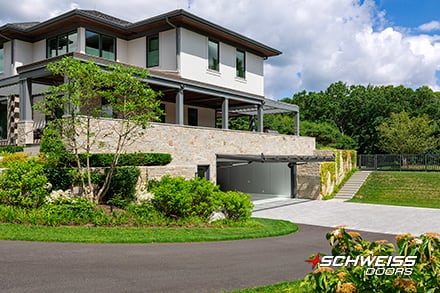
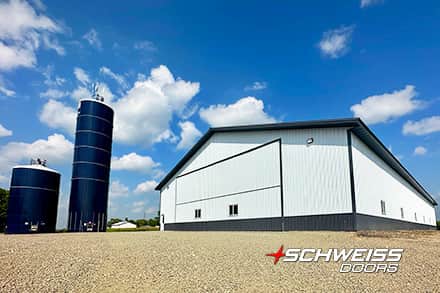
This Boston area home was enhanced by using a glass-cladded Schweiss hydraulic door on the garage, which added function and improved aesthetics. The homeowners, Eddie and his wife, saw a bifold door on a commercial building and found Schweiss Doors through an Internet search. Learning more about the options, they decided a one-piece hydraulic door would be the best fit for the house and Eddie's car collection. The 29 ft. x 9 ft. custom-built door includes a remote opening system, electric photo eye sensors and door base safety edge. |
|
“Vintage” Schweiss Door Owner Decides on a Big Upgrade
In Schweiss' early production days, Keith Peterson and his father, Earl, got a Schweiss bifold door with cables for a quonset shed on their farm. Now many years later, he decided to get another Schweiss bifold door for their new machine shed - this time with the modern lift straps. Keith jokingly calls the old door “vintage”, recounting how he and Earl got the door in pieces and welded it together themselves. The new door is a 18' x 50' bifold door with lift straps and remotes. Keith remarks that it is handy to keep them in the equipment so you can open the door and drive in without getting out. |

|
Pompano Beach Pilot automates his hangar as part of airpark expansion with 10-door bifold upgrade project
Schweiss Doors sent a 10-door shipment to Pompano Beach Airpark in Florida for four hangars, one of which is being leased by Arvid Albanese, who was blown away by the great service he received from Schweiss. All ten doors were 58 ft. x 20.4 ft, windrated for 170 mph and came with bottom mount motors, automatic latch systems, and walkdoors as part of The Pompano Aviation 2 project. |

|
Alaska couple live a pilots dream at their hangar home in Palmer
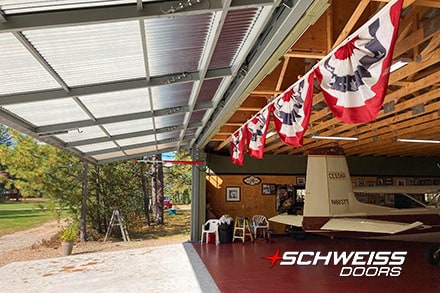
Andrew and Carri Ann Mueller of Palmer, Alaska live in a “pilots dream” home with a 50 ft. x 50 ft. hangar fitted with a Schweiss bifold liftstrap door. Andrew and Carri love their Schweiss Door, even remarking that they wanted to put a big red bow on it upon arrival! |
|
Retired fireman, pilot, drummer, author, likes his Schweiss hydraulic hangar door
Tim Andrew, a retired fireman, pilot, drummer and author fitted a Schweiss hydraulic door on his 48 ft. x 48 ft. hangar where he stores his aircraft and vehicles. Andrew built the hangar himself in Windsock Village Airpark, the fly-in community where he lives in New Hampshire. When looking for a door, a friend told him to forget about his original idea and just go with a Schweiss door, so he decided to get a 39.6 ft. x 10.6 ft Schweiss hydraulic door and he loves it. |

|
Hood River Oregon's Western Antique Aeroplane & Automobile Museum has hot wheels and flying machines
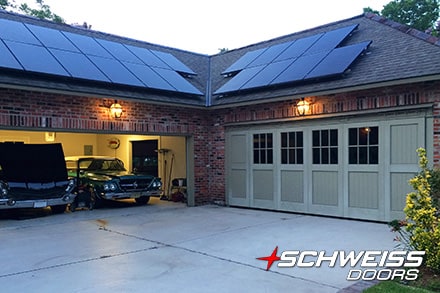
Western Antique Aeroplane & Automobile Museum (WAAAM) has multiple Schweiss bifold doors fitted on the hangars that store their collection of antique aeroplanes, automobiles, and motorcycles. Their most recent hangar expansion now includes a 65 ft. x 22 ft. Schweiss bifold liftstrap automatic latching door. |
|
Hydraulic garage door gives owner enough headroom for his car lift
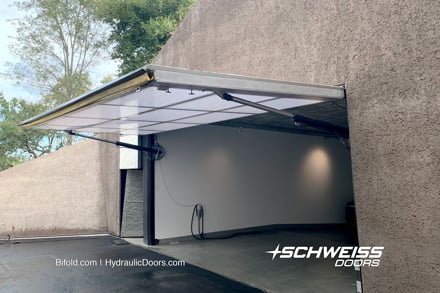
Dr. Frank Bacque loves his 17 ft. x 7 ft. 1 in. Schweiss hydraulic garage door, and he was especially pleased with the service he received from Schweiss Doors. His door is clad with matching wood cladding, has four large glass panels for natural light, and is equipped with remote openers and electric photo eye sensors. |
|
Renowned art collectors choose Schweiss doors for their underground ‘Home for Art’
Pam and Dick Kramlich, renowned media art collectors, chose Schweiss hydraulic doors for their underground home where they also house most of their art collection. The aluminum framed hydraulic doors are a 24' x 10' garage door and a 10.10' x 10.4' loading dock door. Both are equipped with photo eye sensors, door base safety edges, remote openers and are engineered for 85 mph. |

|
SEI Construction goes big time with an 80 ft. and two 60 ft. bifold hangar doors
SEI Construction of Morristown, Tennessee decided to go BIG with three large Schweiss bifold hangar doors at Morristown Regional Airport, where they keep their aircraft. The largest of the three bifold liftstrap doors is a Schweiss 80 ft. x 28 ft., two others tip the scales at 60ft. x 24 ft. These hangars include a 100 ft. x 120 ft. hangar that houses a Cessna Citation 10 Elite 750 jet and features a conference room, breakroom, showers, laundry room and kitchenette. |

|
XINSURANCE founder chooses Schweiss for hangar home
XINSURANCE and Prime Insurance Company founder, Rick Lindsey, chose Schweiss Doors to fulfill his need for a door to put on his connected hangar garage. He chose an insulated 30 ft. by 14 ft. Schweiss Lift-Strap Bifold Door, wind rated for 90 MPH and equipped with remotes and auto latches, to get the job done. This hangar is where he stores his MD 350F, which he uses to commute to his businesses, as well as storing other vehicles, motorcycles, and other equipment. |
|
The Lodge at Geneva-on-the-Lake, Ohio offers a fun stay for the entire family
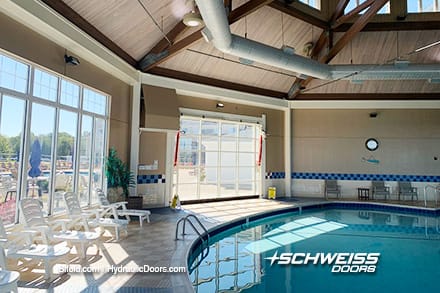
The Lodge at Geneva-on-the-Lake, Ohio is a premier vacation destination with breathtaking views and many amenities, including a Schweiss hydraulic glass designer door. The 15.7 ft. x 11.4 ft. door, equipped with photo eye sensors, is fitted on the building that houses their indoor pool, connecting the indoor and outdoor spaces for a truly dynamic experience. |
|
Architectural friends collaborate to design Salt Lake City home for their ski coach
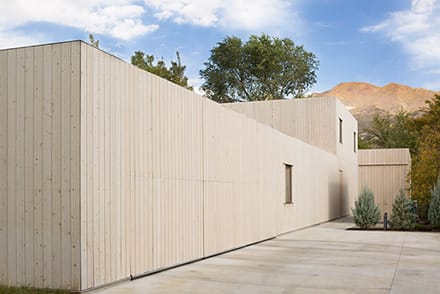
This energy-efficient home located at the base of Salt Lake City, Utah's Wasatch Mountains utilizes three 11.2 ft. x 9.6 ft. Schweiss bifold liftstrap garage doors that are clad with red cedar to blend in perfectly with the rest of the home, a design choice made through the collaboration of two architectural friends. |
|
Amelia Earhart Hangar Museum takes you back in time to the escapades of a famous female pilot
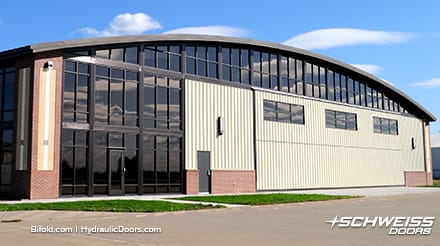
The new, multi-purpose Amelia Earhart hangar facility in Atchison, Kansas has a Schweiss 69.4 ft. x 19.7 ft. bifold liftstrap door with automatic latches and three large windows located high on the upper half of the door to let in natural light. It will not only serve as a museum, but also as an airport terminal and community gathering space. |
|
Schweiss Doors helps Okoboji, Iowa drive-in church open door to prayer
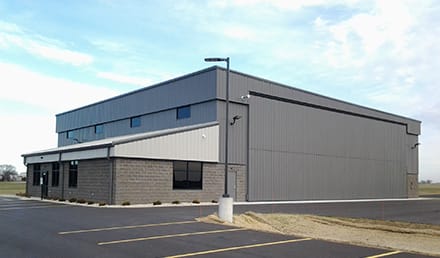
The 35 ft. x 14 ft. Schweiss bifold door on the front of the outdoor stage at First Lutheran Church in Okoboji, Iowa opens wide and provides a nice shaded and weather protected canopy from where the weekly sermon can be conducted. The drive-in style sermon attracts many parishioners, sometimes filling up the parking lot with as many as 265 cars in one day! |
|
Wisconsin 'Cloudkisser' hangar makes for a luxurious home for Citation jet
This slick 100 ft. x 100 ft. hangar fitted with a Schweiss liftstrap/autolatch bifold door houses an equally slick Citation jet named Cloudkisser II by owners Gary and Sondra Bertrand of Ataraxis Holdings, LLC. The 80 ft. x 22 ft. door is windrated at 115mph and is equipped with remote opening. |

|
Oregon kit plane owner praises his zero maintenance bifold strap door
Ron Sterba, a retired telephone company employee from Salem, Oregon praises his 37' x 19.9' bifold liftstrap/autolatch door. He installed the door on his personal hangar where he stores his homebuilt Van's RV-9A, an American two-seat, single engine, low-wing airplane. His door has been operating for 12 years and he praises that it has never needed any service. |

|
International Door Tech of the Year plies his expertise on Schweiss Door installations
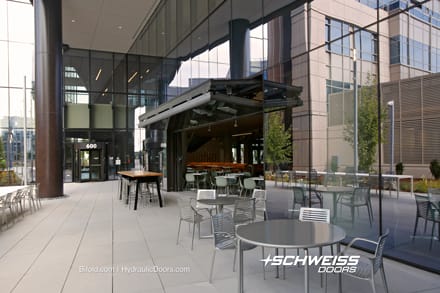
Matt Faupel, a Master Door Installer from Door Systems Vancouver in British Columbia, was recently afforded the honor of being awarded the title of '2021 Door Technician of the Year' by the International Door Association. He's installed thousands of doors over his 20 year long career, and Schweiss doors are some of his favorites. |
|
Bay area pharmaceutical company has bifold designer doors on new building
This 24'x10.10' Schweiss glass designer door is one of three that were installed at Genentech Pharmaceutical in the San Francisco Bay Area. The bifold liftstrap doors are used in their newest building and open up café areas to outside dining. If there is a security breach in any of Genentech's buildings the doors will automatically shut. |

|
Ray Fowler is a man of the sky . . . and he's seen a lot of it
Lt. Col. Ray Fowler has been deployed on multiple combat tours in Syria, Afghanistan and Iraq. He loves his new Schweiss Bifold door hangar. He also flies an Airbus 319, 320 and 321 for Delta Air Lines, but his passion is flying warbirds. |
|
Schweiss Designer doors open chic West Palm Beach, Florida restaurant
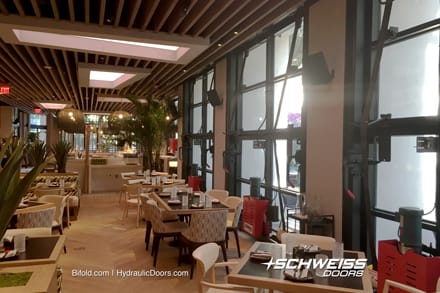
The newest PLANTA restaurant in West Palm Beach, Florida has three Schweiss glass designer doors that open to outdoor seating. Schweiss bar top window serves the outdoor bar. Two of these doors are 8.10 ft. x 11.5 ft., the largest is 11.2 ft. x 8 ft. and the smallest in width is 5.10 ft. with a clear opening of 8.11 ft. Each door is equipped with gray liftstraps and manual latch systems with side latch switches. |
|
Ornate bifold designer doors are focal point to entrance of Seattle Passive House luxury apartments
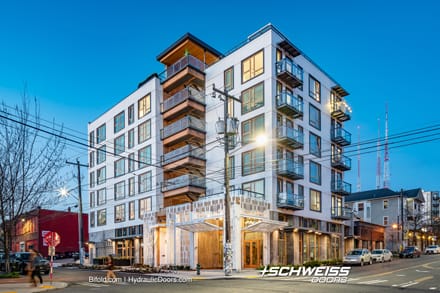
Solis Apartment complex in Seattle, WA is a truly unique building in a category all its own with two ornate Schweiss 12 ft. x 12.10 ft designer doors. It blends luxury living with uncompromising passive energy standards. Schweiss Doors played a part in this with its inclusion of two 12'10" x 15'7" custom-made decorator designer bifold doors. The bifold liftstrap doors have top-drive motors, an automatic latch system and door base safety edge construction. |

|
The hydraulic door Hangar at 743 is home to the Warbird Factory
The Warbird Factory is pleased with its 60ft x 20ft Schweiss hydraulic door that was sold after another Schweiss door survived a hurricane in Florida. This air conditioned 80' x 80' hangar located on the runway of the Albany International Airport, transforms into a reception hall large enough to host up to 300 people for a sit-down dinner creating an ideal setting for military ceremonies or weddings. A decked-out event venue, the building also features 4,500 feet of office space and other amenities. |
|
Elaborate Brooklyn, N.Y. campus project features 10 Schweiss designer doors
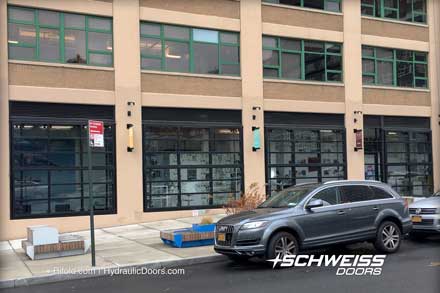
Ten Schweiss bifold liftstrap doors were installed on the five-building Dumbo Heights campus along the East River in New York City. They comprise more than 1.2 million sq. ft. of exceptional office, retail and high-tech space. It is on the ground floor level where 10 Schweiss glass bifold designer doors were placed on two of the buildings; eight on one building and two on another. The Bifold liftstrap doors range in size from 20' 5.38" wide to actual clear opening heights of 10' 11." |

|
Internet search and research leads Austrian contractor to Schweiss Doors and a tour of the Schweiss factory
KAT.AT building contractors, headquartered in Vienna, Austria, ordered five Schweiss bifold liftstrap hangar doors. The doors range in width from 63.5' (19.3m) to 43.5' (13.2m) and heights up to 23.8' (7.2m), and were placed on three new commercial rental hangars at the Wiener Neustadt East Airport near Vienna. |
|
Fighting Illini look to Schweiss doors for new Memorial Stadium Performance Center
The University of Illinois has three Schweiss bifold glass designer doors on its new Memorial Stadium Performance Center. The Performance Center is part of a $79.2 million upgrade that is being used to enhance football recruitment and fundraising at the college. |
|
Architect and homeowner look to Schweiss for unique hydraulic T-Top boat designer garage door
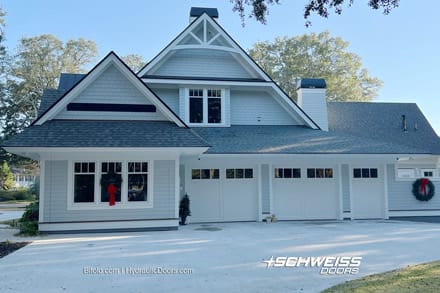
South Carolina homeowner looked to Schweiss for a hidden hydraulic T-Top boat designer garage door. The house's overhanging rake soffit would have conflicted with the door. To overcome that they had to notch the top of the door on each side with custom cut corners at the roofline to give the door opening an extra 1.5 ft. of height. The notch they created gave them the height they needed for "hidden" 14 ft. tall x 12 ft. wide door to fit his T-Top boat. |
|
Where's the Garage Door? Hidden Bifold Door
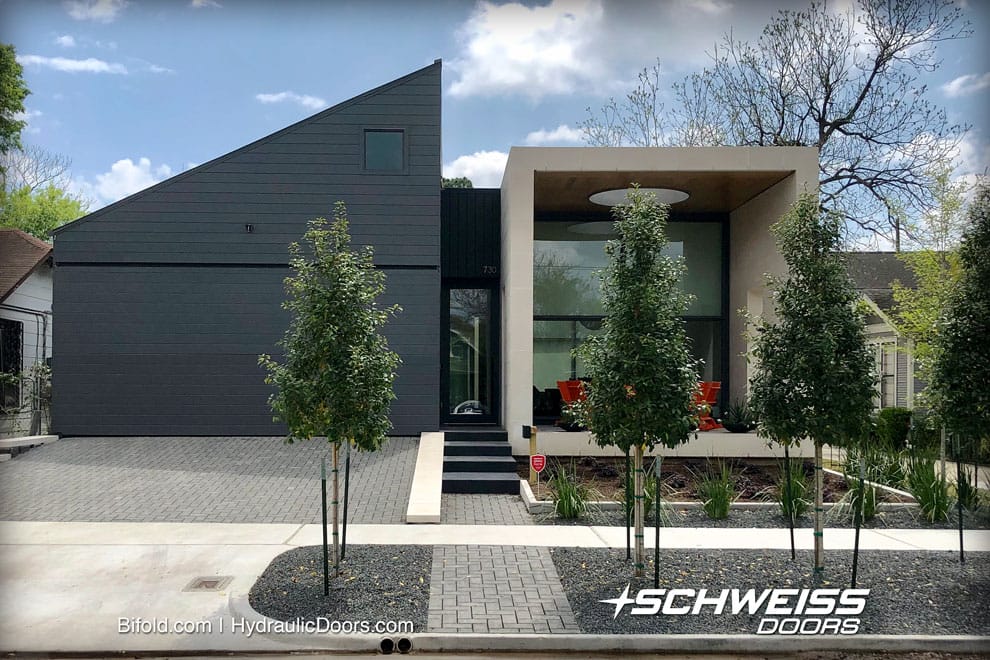
Wayne Braun of Houston, Texas was the Principal in Charge of Design for PDR Corp. and is pleased with his 21' x 10' Schweiss bifold two-car garage door. The way it was installed makes it nearly invisible from the outside as it blends in with the matching siding on his modular home. The bifold liftstrap designer door on Braun's two-car garage is equipped with an automatic latch system, electric photo eye sensors and remote opener, and when closed, the door cladding on the outside of Braun's "flush overlay" bifold door gives the appearance of a one-piece door. |
|
Spy Hop digital media arts group moves into new high-tech Utah student complex
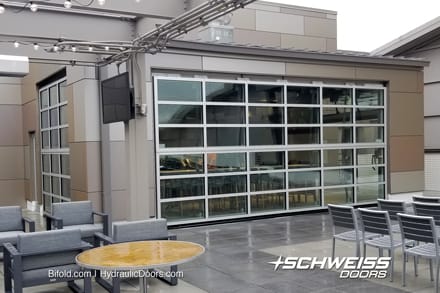
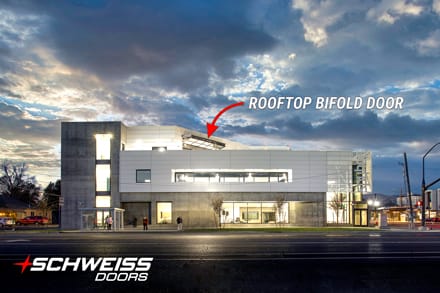
Spy Hop Productions of Salt Lake City, Utah now has a new "Rooftop" performance area separated by a Schweiss glass bifold liftstrap/autolatch door. Jason Foster, Partner in Charge of designing the Spy Hop project from Atlas Architects in Salt Lake City, said there were two unique elements to the new Spy Hop Productions media arts center; one being the third-floor dedicated event space that they didn't previously have, and the Schweiss Designer glass door. |

|
Beautiful Saskatchewan hangar renovation is accentuated with two Schweiss hydraulic doors
Curtis Lemieux, pilot and owner of Econo Lumber in Prince Albert, Saskatchewan, renovated his hangar with two hydraulic doors. The largest of these two hydraulic doors is a 54 ft. x 16.9 ft. (1,646 cm x 515 cm) It has four windows to take advantage of available light. The smaller adjacent 13.3' x 8.11' (405 cm x 247 cm) hydraulic door is used for a storage area and is where both hydraulic door pumps are also located. Both doors are equipped with remote openers. The entrance to the front of the 70 ft. x 70 ft. Lemieux hangar has a backlit model of Lemieux's Cessna Citation C510 Mustang. |
|
Bifold corporate jet hangar door is first of its kind in Central America
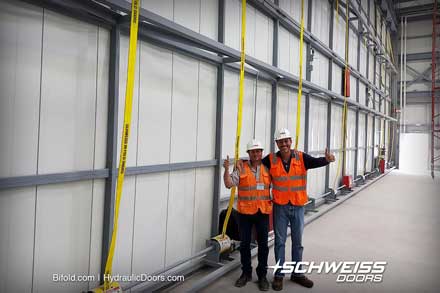
CILC Central America Corp heading up ordering, shipping and installation of the 79.9' x 21.11' Schweiss bifold hangar door in San Jose, Costa Rica. Here Rafa Ramirez, left, and V.P. of Operations, Chris Villegas Solera. give the thumbs up after installing their first bifold door. |

|
Repeat bifold door business comes from Texas hangar owner
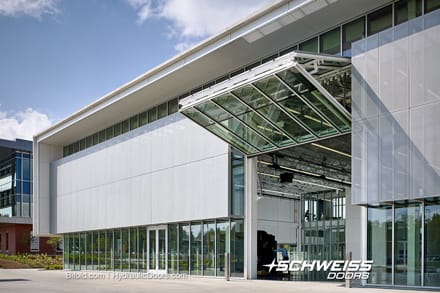
Mike Wagner's Mooney M20J fits nicely in his new 42' x 82' Godley, Texas hangar equipped with a 40' x 14' Schweiss bifold liftstrap door. When opened the bifold door provides a shaded canopy for the hangar. The 40' x 14' bifold/liftstrap door has an automatic latch system, remote opener and was painted red at the factory. This was the second time Wagner had ordered Schweiss Doors; the first time, back in 2006 it was for a 50' x 16' bifold strap door with manual latches for his excavation company. |
|
Community College with Schweiss bifold doors earns LEED Gold certification
This beautiful bifold glass designer door opens to the bay on the Innovation Central space at Metropolitan Community College in Omaha, Nebraska. The liftstrap autolatching door is 18.4' wide x 26.5' tall. |

|
Colorfully clad hydraulic designer door shines through Boulder, Colorado office
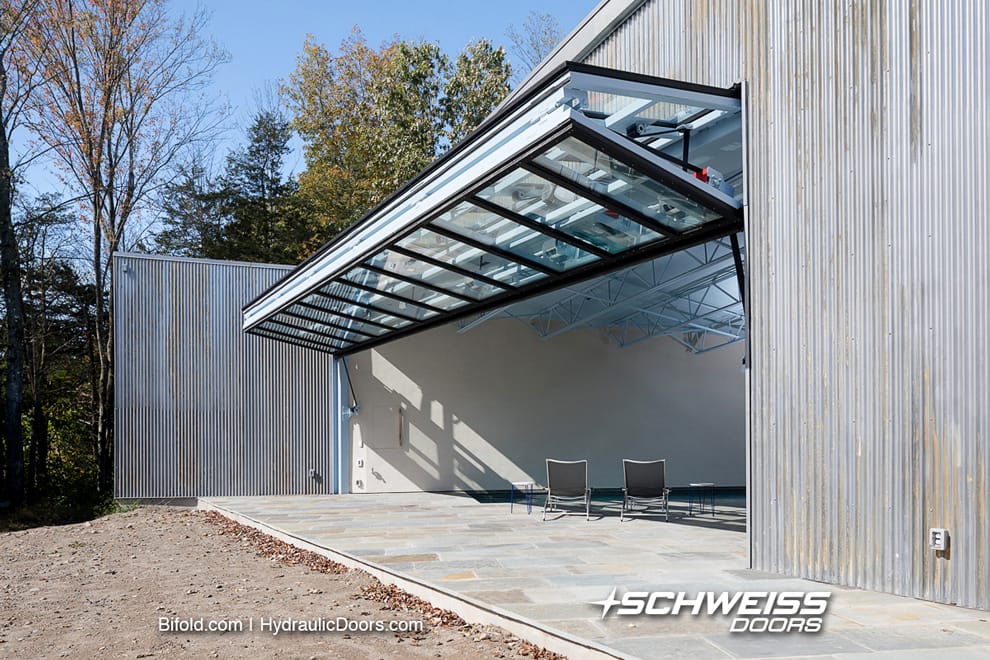
A Schweiss 36.7 ft. x 9.11 ft. hydraulic door connects an area to the inside of the Boulder, Colorado office space to a green outdoor space for employees. This Prism Plane project by Tres Birds Architectural uses a Schweiss hydraulic door to create a beautiful artistic look without high end cost. The door is clad with curtainwall glass with colored films layered inside the laminated glass. |
|
'American Dream' New York pool house has Schweiss 34 ft. glass and mahogany designer door
Taking up the entire south sidewall of this Accord, NY pool house is a Schweiss bifold double-glazed glass door that extends 34.4' across and 13' tall. It is clad with glass and trimmed with mahogany on the outside."The pool house is a year-round play, swim, exercise, and recreational sanctuary," said Principal Architect, Douglas Gauthier. |
|
A baker's dozen Palmer, Alaska hangar and T-Hangar doors have bifold doors
Cruz Construction flies out of its largest 80 ft. x 140 ft. hangar located at The Warren "Bud" Woods Palmer Municipal Airport in Palmer, Alaska. The hangar has a 78 ft. x 26 ft. Schweiss bifold liftstrap/autolatch door. They have another 40 ft. x 12 ft. bifold strap door on a hangar at Copper Center and 10 more bifold doors on T-Hangars built for resale. |

|
The doorway that led to the creation of Midwest Flyer Magazine
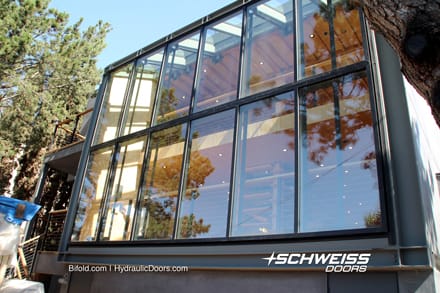
Dave and Peggy Weiman, publishers of "Midwest Flyer Magazine," recently upgraded their office hangar with a Schweiss 39 x 10 ft. Hydraulic Door. They are publishers of "Midwest Flyer Magazine" of Oregon, Wisconsin, and their 1976 Cessna 182P Skylane is use to call on clients and attend aviation events. |
|
Santa Monica luxury home glass bifold door opens to an ocean view
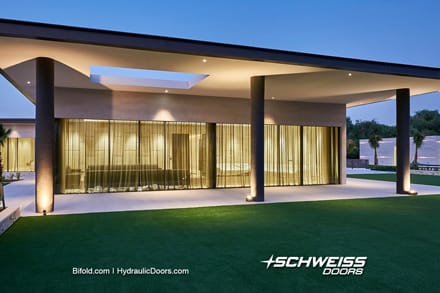
This home in Santa Monica, Calif. has a Schweiss custom-made 21.4' x 13.2' bifold designer door that overlooks the ocean from behind the home. The Schweiss bifold designer door is equipped with a manual latch system, top-drive motor, black liftstraps, photo eye sensors and weather protected roof-mounted motors. The doors have Organ glass on them that are double-glazed with gas between to make them more energy efficient. |
|
KAT Residential Villa in Dubai features three Schweiss bifold designer doors
The luxurious new KAT Residential Villa was constructed within the Nad Al Shiba area of Dubai utilizing two Schweiss bifold doors. It covers multi-levels totaling an area of 38,000 sq. ft. KAT, established in 2016, is a team of chartered surveyors with vast experience in multi-storied residential and commercial buildings. |
|
Aurora Sky Palmer, Alaska hangar adds a needed service for Matanuska Valley pilots
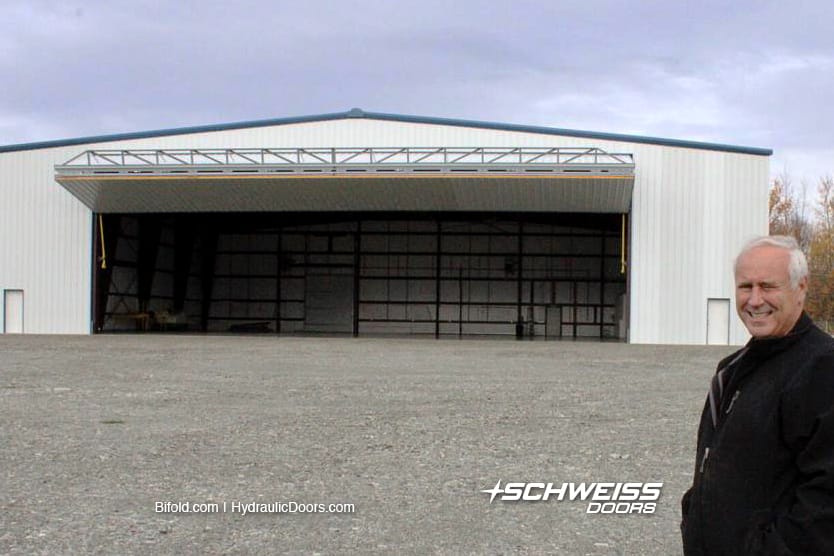
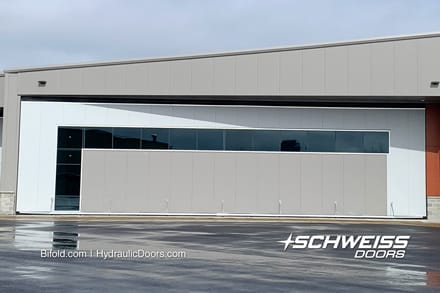
Terry Cosgrove stands outside his new Aurora Sky Palmer, Alaska rental/lease hangar with 80 ft. x 22 ft. Schweiss bifold liftstrap door. The biggest part of his business is a recently completed 12,000 sq. ft. hangar that opens with a Schweiss 80 ft. x 22 ft. clear opening bifold liftstrap/autolatching door. The door is windrated at 130 mph and weighs 22,583 pounds. |
|
Oregon corporate hangar was built with 'tall' Schweiss hydraulic door in mind
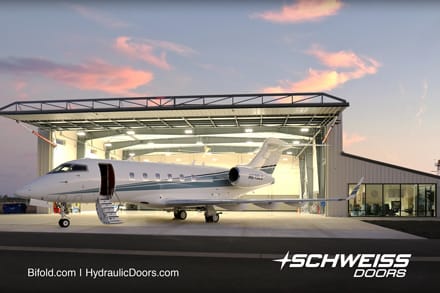
The Lanz Cabinets Bombardier Challenger 300 business jet sits proudly in front of its new corporate hangar in Eugene, OR with 76' a hydraulic door. The interior of the hangar is very well lit and exterior lights beside the top of the Schweiss hydraulic door make it easier for the pilot to enter the hangar after dark. |
|
Upscale Lake Hood, Alaska hangar features bifold and hydraulic doors
The three-stall Lake Hood, Anchorage, Alaska hangar, owned by Jim St. George, has a 65' and 40' hydraulic doors and a 34' wide bifold door. When you first see the 14,000 sq. ft. hangar you can't help but notice the decorative window design. |
|
'Net Zero' Washington Bonneville Power project features 11 Bifold drive-through doors
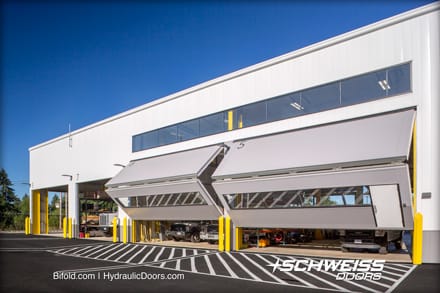
Bonneville Power Administration (BPA) features 11 Schweiss Bifold liftstrap doors on its maintenance building. Eight of these doors are 27' x 16'. One other door is 23.4' x 16' and the remaining two are 12' x 16' doors. BPA maintenance building had a "Net Zero" criteria, and Schweiss met the requirements. |
|
California Emergency Operations Center opts for Schweiss hydraulic designer door
The new Martinez, California County Operation Center has a custom-made 23.1 ft. x 13.9 ft. Schweiss hydraulic glass door that opens up for meetings. It seats 160 inside and an additional 140 people outside. The Schweiss custom-made hydraulic glass designer door is equipped with electric photo eye sensors, a door-base safety edge and a hydraulic back up system in case of a power outage. |
|
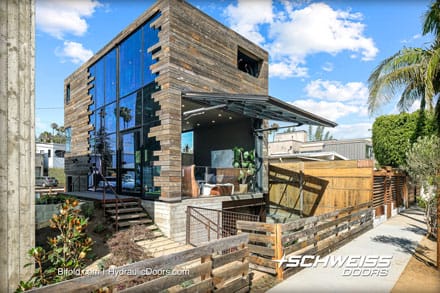
Modernistic Venice, Calif. home has hydraulic living room designer door
This split-level rental home, owned by Architect Matthew Royce, is equipped with a custom-made Schweiss 13.8' x 10.8' one-piece hydraulic designer door. Royce, who also served as its general building contractor, installed the door with electric photo eye sensors and the door is clad in glass. What's really unique about the home is the hydraulic door opens from the living room to overlook a private outdoor patio and lets fresh air into the home. |

|
Initiative to develop premier aircraft care products leads to new hangar with 115 ft. hydraulic Schweiss door
John Mosley, owner of John's 360° Coatings in Mississippi, built this hangar complete with a Schweiss Hydraulic 115 ft. x 23 ft door. The AeroShell Aerobatic Team is a familiar name in airshow lineups, having performed in front of millions of fans all over North America for more than 25 years. They love the "John's 360° Coatings" that John Mosley put on their T-6 WWII vintage aircraft. The T-6 was originally introduced as a basic trainer for the U.S. Army Air Corps in 1938. |
|
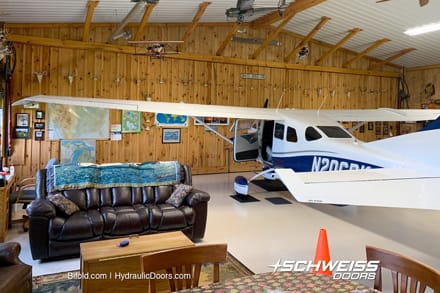
Michigan hydraulic hangar door is more of a hangar mancave wall
Gary Huffman of southern Michigan is an avid outdoorsman and pilot/instructor. His hangar has a 43.7' x 11.1' custom-made Schweiss hydraulic door. The hydraulic pump is hidden away in a white pine box he made to conceal it. He flies an absolutely gorgeous 1978 Cessna 206 Stationair and a pristine totally rebuilt 1948 four-place Stinson 108 Voyager. He takes off and lands from a 1,800 ft. north/south runway and 1,300 ft. east/west crosswind runway. |
|
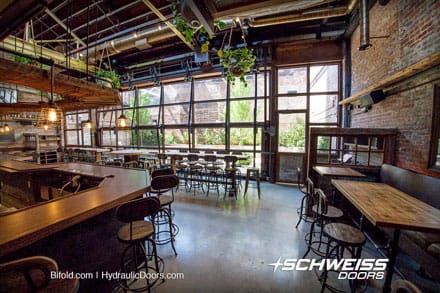
Designer bifold door is the perfect fit for new Brooklyn Italian restaurant
Brooklyn New York's Ainslie Italian restaurant, has a 30.6' x 13.4' Schweiss Bifold Designer Door that opens to a bar and landscaped yard. The liftstrap door opens backyard for customer comfort and more seating. It has a keyed entry, remote openers, top-drive motors and black liftstraps. Glass walk doors are positioned at each side of the bifold door. |
|
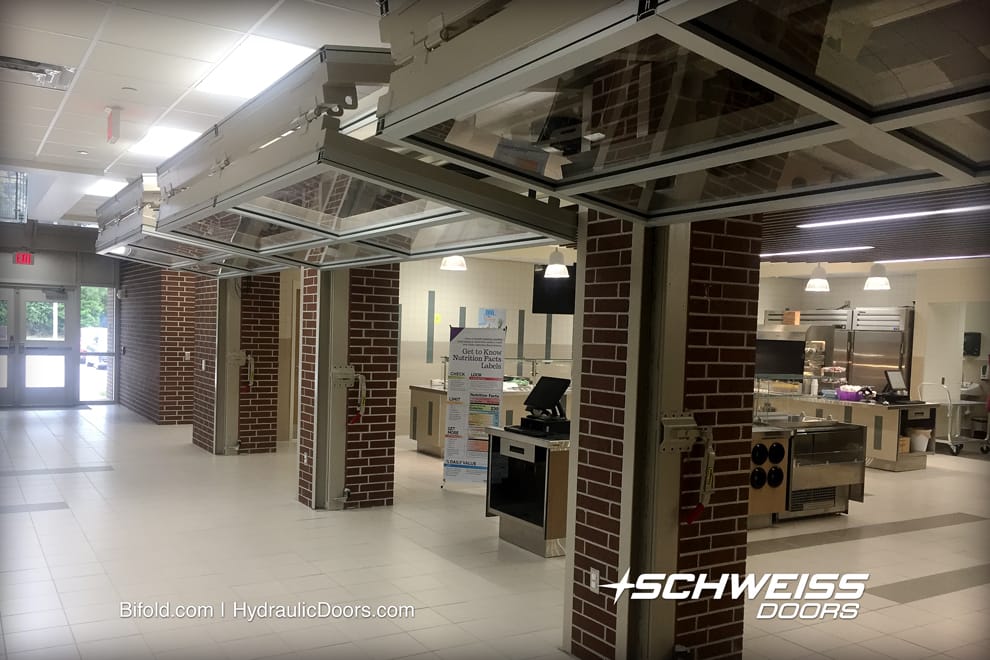
Early college Texas high school includes Schweiss bifold doors in new construction
New Caney High School buys glass designer doors for commons area. They range in size from 11.6' wide to 9.3' and all have clear heights of 7.75'. The liftstrap doors, powered by top-drive motors are equipped with electric photo eye sensors, door base safety edges, manual side latches and black liftstraps. |

|
Sailplane hangar is something many pilots only dream about
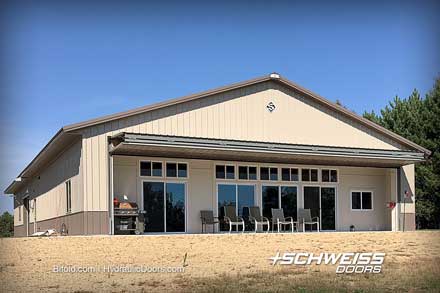
This four-plane hangar in Georgia has a Schweiss 60' x 12.5' bifold liftstrap door. Inside it is decked out with 15' x 32' mancave. The door was hung by Premier Building Systems of Lawrenceville, Georgia. Vihlen said he finished the installation by putting in the motors, liftstraps and autolatches all by himself. Now, Steve's main passion these days is flying sailplanes. He's got an American-made older classic 1964 Schweizer 126-B glider and a German-made Alexander Schleicher ASG-29 modern single-place racing glider that he bought new from the factory in 2006. |
|
Beautiful home away from home has bifold door for scenery and security
Ron's 40' x 11' Schweiss bifold liftstrap door works as a security system and protects the glass windows. The automatic latching system seals it weathertight. The building is about 48' x 92' with one third devoted to living space and the rest for a garage and shop area. When his home was built a couple of years ago he decided to put a bifold door on it, in part to cover a large 40' expanse of windows that look out over an adjacent golf course. His home in the woods overlooks his 90 acres. |
|
Mercedes-Benz and Schweiss Doors travel the same route of class and quality
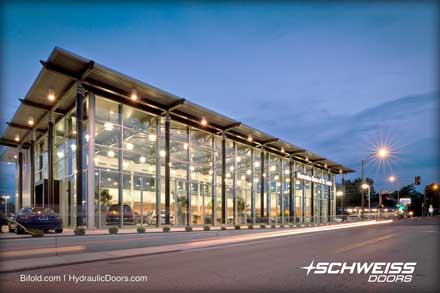
When Mercedez-Benz of St. Louis built a new dealership and parking garage on Hampton Avenue, a Schweiss bifold glass designer door was put up. The Schweiss bifold liftstrap door measures 23.11' x 9.4' and equipped with electric photo eye sensors, manual latch system, a door base safety edge, black liftstraps and a top drive motor. PARIC Corporation of St. Louis built the 90,000 sq. ft. building and Zumwalt Corporation of St. Louis installed the bifold door. It is a full-service dealership offering new and used models and a service department. |
|
Texas country home is highlighted by attractive Schweiss hydraulic designer doors
At the encouragement of their architect, these Chappel Hill, Texans decided on Schweiss hydraulic country ranch home and garage designer doors. The doors are 29.7' x 9.7' and 20' x 9.4'. The compact hydraulic pumps are each mounted 45' and 65' from the doors. One of the hydraulic pump units went in the basement of her home away from the party room. The pump in the garage was put in the mechanical room behind doors. The exterior of the door is clad in 24 gauge metal panels and the interior of the basement door is handsomely clad with Vertical Douglas Fir. |

|
Chuckey, Tenn. barn hangar holds replica of 'Spirit of Columbus'
Driving up you'd never guess that his barn is almost exclusively used to hangar his 180 Cessna 'Spirit of Columbus' and the end wall has a bifold door. Dick and Ginger Merrill of Chuckey Tenn. replicated their 1953 Cessna 180 to match the paint scheme of famous female aviator, Jerrie Mock. |
|
Bifold garage door in The Woodlands, Texas has class to match cars within it
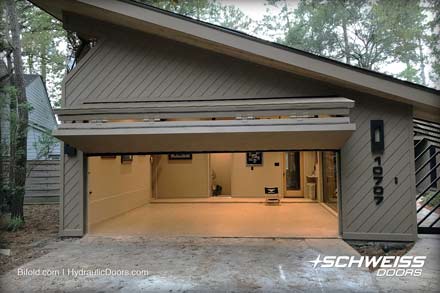
A complete remodel of this Woodland, Texas garage included a Schweiss 18' x 7' bifold liftstrap door. The door is equipped with an automatic latch system, remote opener and Simonds can use his backup generator to open or close the door in case of a power outage. That backup generator nearly went to work. The door was installed in the nick of time before Category 4 Hurricane Harvey started on its $200 billion wave of destruction when the eye of the hurricane passed over Rockport and Houston in late August. |
|
Blue Bottle Coffee Company opens doors to convivial and growing customer base
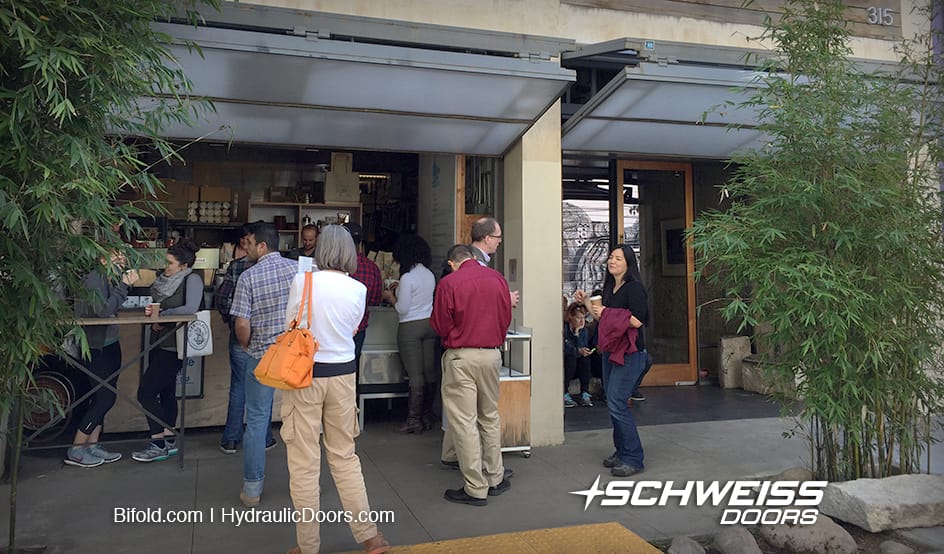
Blue Bottle Coffee Company in San Francisco, Calif. turned a dead-end alleyway into a friendly gathering place for people to enjoy their coffee. They have two Schweiss 11' wide bifold doors that they can open to serve customers each day. |
|
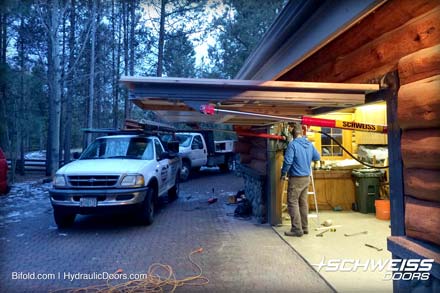
Custom home hydraulic garage door aids in resale of log home
This door in Oregon is a cedar clad Schweiss designer door with a large man door entrance on a log vacation home two-car attached garage. The new custom-made residential hydraulic garage door is 14' 10" wide with a 6' 3" clear opening and was bought for maximal headroom. The Schweiss Doors is a extra selling point for the owner that put the home up for resale. |
|
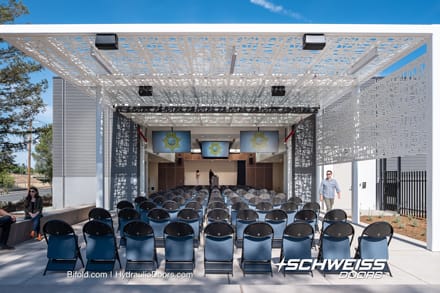
Connecticut H.S. has multi-use bifold stage and amphitheater door
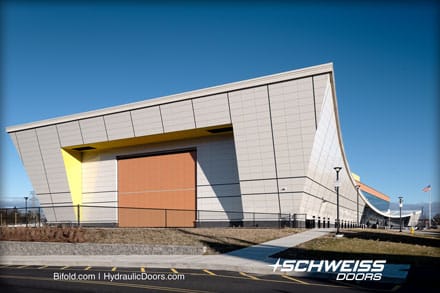
The new $107 million Warren Harding High School in Bridgeport, Connecticut has a multi-purpose Schweiss bifold liftstrap door measuring 34.8' x 20'. The door doubles as an amphitheater and stage for indoor and outdoor performances. |

|
Microburst damage leads Chandler Aviation to replace door with a Schweiss bifold liftstrap door
Extensive storm damage to the Chandler Aviation building in Chandler, Ariz. forced the owner to have an old cable door replaced by Schweiss Bifold Doors. His building needed a revamp from roof to floor including 48' x 14' 10" liftstrap door. The door is equipped with a manual latch system. Four translucent polycarbonate panels at the top half of the door allow natural daylight to brighten up the inside of the building. |

|
Prime Silicon Beach real estate site is using Schweiss bifold door at Pen Factory
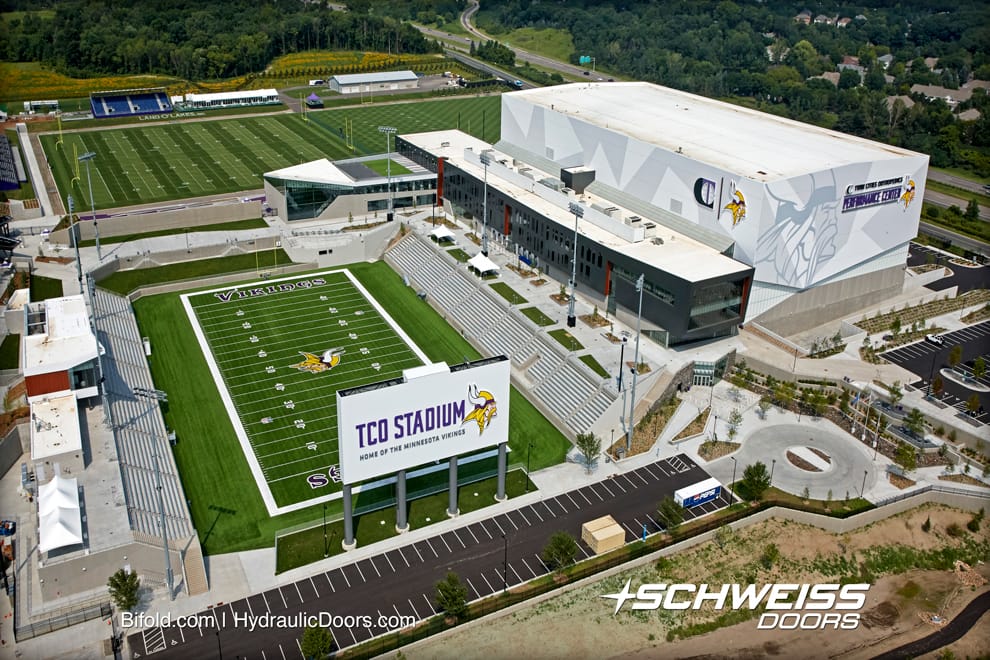
On this Pen Factory prime real estate at Santa Monica's Silicon Beach sits a 8' 9" x 19' 5" Schweiss bifold liftstrap door with glass cladding. It is equipped with an automatic latch system, electric photo eye sensors, a door base safety edge and back-up system that can be used in case of a power outage. Installation of the door was by Bill Schmidt of ABS Builders, Inc. of Maxwell, CA., the same firm that recently installed the five large 29'x41' Schweiss bifold doors on the new Sacramento Kings Stadium. |
|
Skol Vikings!
|
|
Tall 62 x 60-footer goes on Portland Yacht Services building
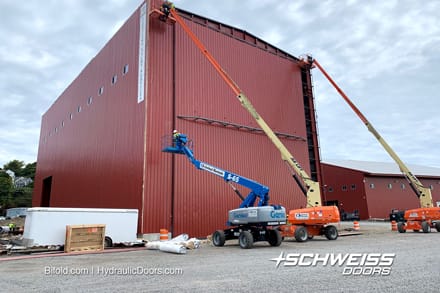
This big 62-foot wide x 60-foot tall bifold liftstrap door at Portland Yacht Services, Maine, was the second tallest door ever manufactured by Schweiss. The tallest door was 69-foot tall and 90-feet wide, made for a rocket hangar at Cape Canaveral. Ten windows on the door bring in natural light. |
|
Oklahoma City garage exudes class from floor to ceiling and door
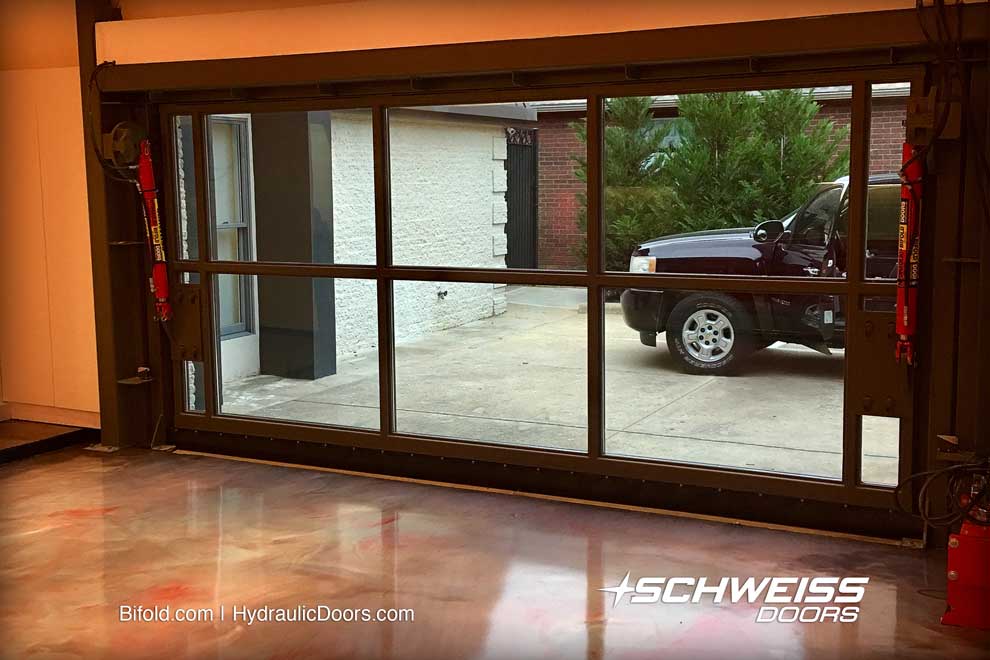
Leo Kingston buys a Schweiss hydraulic door with a clear opening of 15.3' x 7.1' and its equipped with electric photo eye sensors and a remote opener. In order to give extra stability, to compensate for the extra weight of the glass-clad door, Kingston ordered it with a freestanding header that attaches to I-beams at the side and header of the door. |
|
West Coast Self-Storage bifold doors enable developer to meet downtown criteria requirements and save money
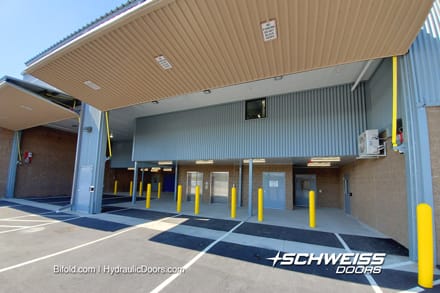
Two Schweiss bifold doors, a 35 ft. x 19' and a 27 ft. x 19 ft. cleared up a city permit quandary and are being used to access loading bays and elevator lobby. Two hydraulic freight elevators take the work out of bringing storage holdings to the top two floors. Customers are only permitted to access the floor their unit is on through the use of a keypad that is interfaced to the elevator. |

|
Iowa high school aviation academy has a Schweiss hydraulic door on its new hangar
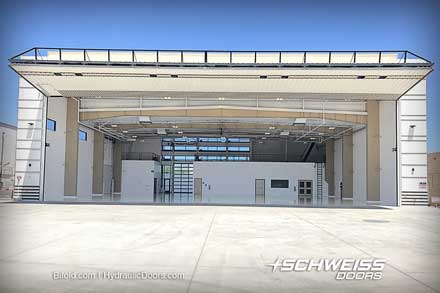
Des Moines Aviation Academy builds new hangar. Their new 100' x 96' hangar has a 58.2' x 19.5' Schweiss hydraulic door equipped with electric photo eyes. The One-Piece Door was also ordered with manual windpins, warning lights and horns. The facility consists of a main hangar, mechanical shop, tool/equipment rooms, classrooms and office space. Building contractor on the school was DDVI of Indianola, Iowa. The door was installed by Skold Door Company of Des Moines. |
|
Arizona corporate jet hangar has 86' Schweiss bifold liftstrap door
The new 7,360 sq. ft. Triple C Airpark Properties hangar in Scottsdale, Ariz. has a 86' x 26' Schweiss bifold liftstrap door. Schweiss Doors was called upon to provide a bifold liftstrap door with an automatic latch system for it. The massive door has 24 windows located on both halves and a walk door. An exterior truss gives additional strength to the door. The hangar is part of a 12,600 sq. ft. building that has 2,620 sq. ft. of offices, shop and storage space. |
|
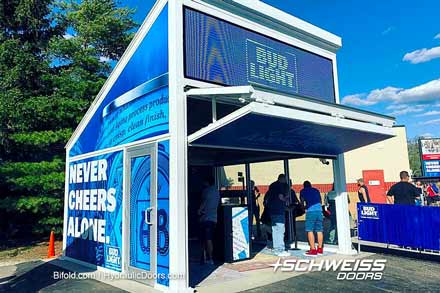
Thirteen Schweiss hi-tech container doors
The custom-made doors are 13’3” x 7’2” with manual latches and have a 145 mph windload. They have white liftstraps and the motors were painted white as well. The outside of the bifold door was clad in ACM panel. ACM provides a flat surface comparable to much thicker aluminum, at a more reasonable price. When you desire larger panel modules or panels with greater impact resistance, aluminum composite material is the way to go. |

|
Ornate cafe-kiosk is part of San Francisco revitalization project
San Francisco's Bi-Rite kiosk offers the first time food has been available on the Civic Center Plaza. It has five beautiful Schweiss bifold designer liftstrap doors. These five doors open up on all sides and when they are closed they blend into the building design to where you can't really see that there are doors there at all. The largest door is 49.4' x 12' and the four other liftstrap doors vary in size from 16.8' to 12.11' in width. |
|
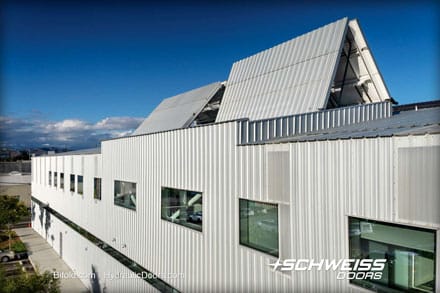
Rooftop skylight bifold doors enhance natural light for California photo studio
Eight Schweiss liftstrap skylight designer doors were placed on a photography production studio building in Los Angeles, Calif. Six of these are on the rooftop. The idea came at the recommendation of the Culver City, Calif. architectural firm of Eric Owen Moss Architects (EOMA). These custom-made skylight doors, two of which are 24' x 15.2' and four that span 23.5' x 14.2,' were in addition to two other 23.6' x 15' bifold liftstrap doors placed on the side of the building. Beneath the skylight doors are 1" thick clear glass panels to keep the elements outside the building. The skylight doors have weatherproof electrical components, and the side doors are equipped with photo-eye sensors. |
|
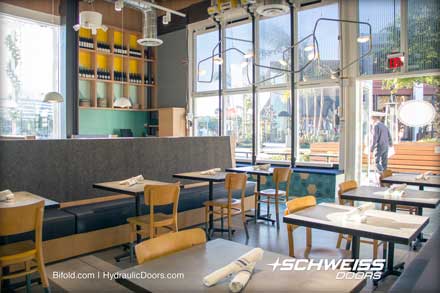
Superba Food + Bread opens its bifold door to a tantalizing menu
People at Superba Food + Bread of El Segundo, California insist on living well. They are a community born of the belief that the good things in life ought to be shared and that great food should be accessible to all who seek it. With good intentions, Superba decided on a custom-made 14' 3.5" x 9' 8.5" glass-clad bifold liftstrap door with black straps, electric photo eye sensors and manual latches. |
|
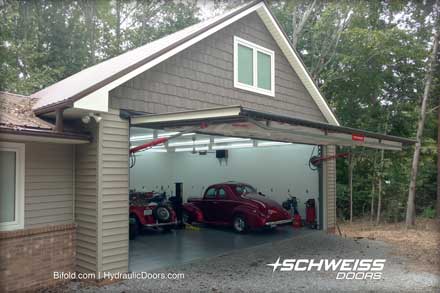
Odd Job Johnny has a 'Now You See It - Now You Don't' North Carolina hydraulic garage door
Dennis Scearce of Mooresville, North Carolina, applied this Herb Korthuis principle to his design of his 25.4' x 9' hydraulic door on his 30' x 30' two story garage. When it's open, it looks every bit like a garage door, but when it's closed it looks just like an extension of his home. With two large double windows, it blends in very nicely and matches the rest of his home exterior. The door has remote opener, photo eye sensors and an interior truss. |
|
Life Flight Network gets 70 ft. bifold door for new emergency response hangar
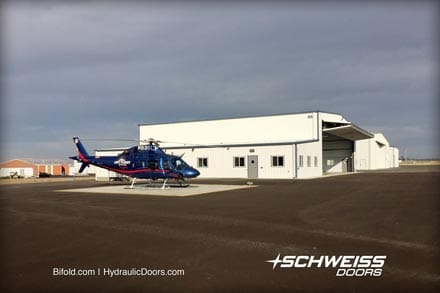
The Life Flight "Koala" helicopter stands ready next to the new hangar that has a Schweiss 70'x17' bifold liftstrap door at Lewiston-Nez Perce County Airport. Using state of the art aircraft and highly skilled medical and aviation professionals, Life Flight Network (LFN) provides life saving transport to seriously ill or injured patients from the scene of an emergency or from one hospital to another. |
|
Ornate bifold grill design adorns Seattle's Pike Motorworks luxurious Apartment building
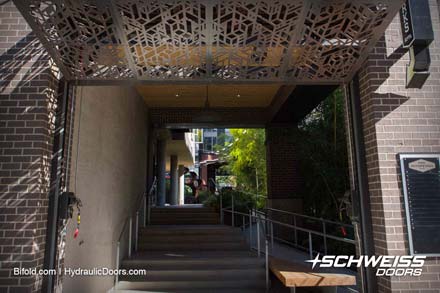
Adding to the historic look of the building are two custom-made decorative Schweiss bifold liftstrap designer doors; one of which is 11' 10" x 11' 11" and another at 11'1" x 10' 1." Instead of the conventional metal, glass or wood exterior cladding, these doors have a decorative exterior 12 gauge steel cladding that blends in very nicely with the exterior brick of the Pike Motorworks apartment building. |

|
Newly opened Boston Art Center uses two unique concept Schweiss doors
The new Watershed art gallery has two unique Schweiss bifold liftstrap designer doors, 19.9' and 19.11' wide by 26.9' and 26.11' feet tall. It will showcase contemporary art and was built from the ruins of an abandoned copper pipe and sheet metal facility. |

|
Bobby Hotel in Downtown Nashville features a 1956 rooftop bus with hydraulic doors
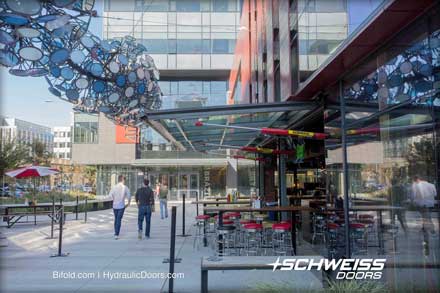
The newly renovated Bobby Hotel in downtown Nashville, Tenn. has a unique landmark, a 1956 Greyhound Scenicruiser bus hoisted 10 stories up on its roof. One side of the bus opens up with a 18’6” x 8’ Schweiss Hydraulic Door and another 8’ x 9’ rear bus door. The bus serves as part of the rooftop lounge. |
|
Two glass-clad hydraulic doors open Sam's Tavern in Seattle to outside dining
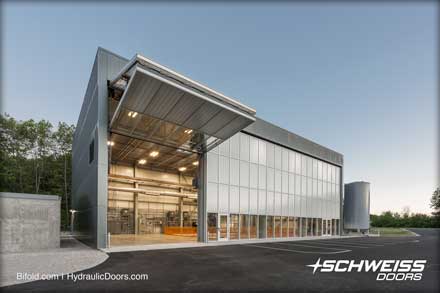
Sam's Tavern Pike Street bar has two Schweiss 11'8" x 9' hydraulic glass-clad doors that open to an outside patio area. The bar in Seattle is acclaimed for its renowned USA Today endorsed Bakon Bloody Mary and great food. The restaurant and bar opened early this year as part of a newly constructed 13-story office building. |
|
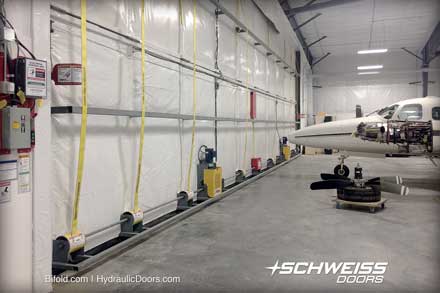
National particle physics lab architect calls on Schweiss for bifold door
As part of the Short Baseline Neutrino (SBN) program at Fermilab a 20.10' x 23.9' bifold liftstrap door was installed in the new 4,500 sq. ft. SBN Near Detector Building. The door features gray liftstraps, electric photo eye sensors, warning lights and horns, a top-drive motor, automatic latching system and an emergency back-up system. The door is clad with glass on the bottom quarter and high performance light transmitting Kalwall® panels covering the top three-quarters of the door, both to identically match the adjacent east wall of the building. |
|
Business at PropWorks is zooming - Schweiss 60' x 16' bifold goes on new Edmonton facility
PropWorks of Canada recently underwent a expansion that included a new 14,000 sq. ft. steel hangar with a 60’ x 16’ Schweiss bifold liftstrap door. The hangar is capable of holding large aircraft like this Piper Cheyenne waiting to have some propeller work done. |
|
Silicon Valley dream home has large Schweiss hydraulic glass Great Room curtain wall
The Great Room of this ultra-contemporary 9,991 sq. ft. Silicon Valley home has natural light flowing through a 23' tall by 36' wide glass hydraulic door that can be opened fully to create a true indoor/outdoor experience. |
|
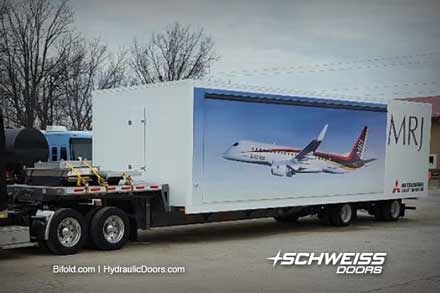
Shomotion is a company on the move
This unique 40' x 12' mobile container was designed and built by Shomotion LLC. Schweiss Doors custom-built a 28' x 7' 11" hydraulic door for it. Inside the container is a prototype fuselage of Mitsubishi's soon to be produced 70 to 90 passenger regional jet. |

|
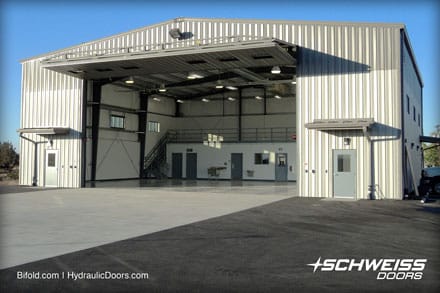
Big 50' Schweiss bifold opens up South Carolina hangar
Nick and Michelle Cwian are enjoying their new 50' x 16' Schweiss bifold liftstrap door. It is attached to their 60' x 70' hangar at Easley, SC. The liftstrap door, located on the 20' tall hangar sidewalls, is equipped with automatic latches. Their hangar holds their Aeronca Champ and an Aeronca Chief. Nick and Michelle live at the Williamsport Airpark. |
|
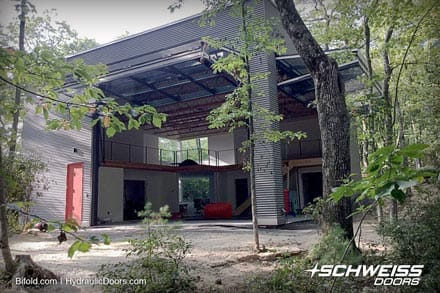
Oregon BPA helicopter hangar has 40 ft. Schweiss bifold liftstrap door
The newest helicopter hanger utilized by the Bonneville Power Administration (BPA) at the Redmond, Oregon airport has a Schweiss 40' 4" x 20' bifold straplift hangar door. |
|
Scenic mountain art studio-retreat is enhanced by Schweiss glass bifold doors
Forming a glass corner in an open two-story space are two 23' x 15'2" straplift bifold glass-clad doors that have electric photo eye sensors, door base safety edges and black liftstraps and quiet, fast opening top-drive motors. The up/down door control is located 60' away from the doors. |
|
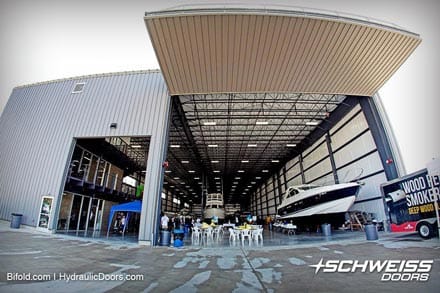
Michigan yacht restoration building is fitted with Schweiss bifold and hydraulic doors
The new fully insulated building also features a Schweiss 47.4' x 29.7' bifold automatic latching liftstrap door and a 45.11' x 34.1' hydraulic door, LED lighting, radiant floor heat, floor drains, 24/7 RFID key card access and a private ramp on the shore of Lake Macatawa. The changes make a transition to and from their beautiful storage/service facility effortless. |
|
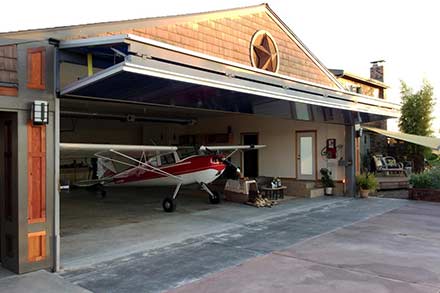
Polycarbonate clad bifold door gives hangar an exclusive look
With the decorative star and patriotic blue front it has all the looks of a hangar home that you might think was owned by Captain America. Jim Weitman, of Weitman Excavation in Sherwood, Oregon, and his wife, Star, live on a private grass airstrip just outside of North Plains, Oregon. The hangar portion of the home measures 40' x 40'. The Schweiss bifold liftstrap door on the hangar has a clear opening width of 38' and 9' 8.75" in height. It is also equipped with automatic latches, electric photo eye sensors and a remote opener. |
|
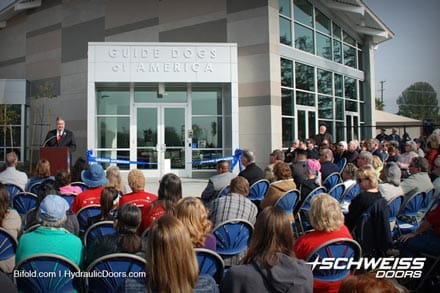
'Guide Dogs of America' found way to integrate mission with bifold door
The 16,000 sq. ft. building has a Schweiss glass designer door measuring nearly 42' wide x 11' tall. The glass bifold liftstrap door blends in nicely with the rest of the buildings windows and architecture, so much so that it is hardly noticeable. The glass bifold door on the GDA building lets in ample amounts of daylight and also gives people within the building a great view of the surrounding mountain range. Two top drive electric motors easily lift the heavy door. |

|
Schweiss bifold liftstrap door goes on beautiful Texas hangar home
"The liftstraps and automatic latch system are slick. I feel a lot safer with straps than a cable that can snap on me. I have one remote control in the plane and another in the golf cart. I'm opening and closing the door without bending over and pulling a pin," explained Jesse. "I like the aesthetics . . .not all doors are created equal; it's a good balance between beauty and functionality, I think it's a industrial-strength door." |
|
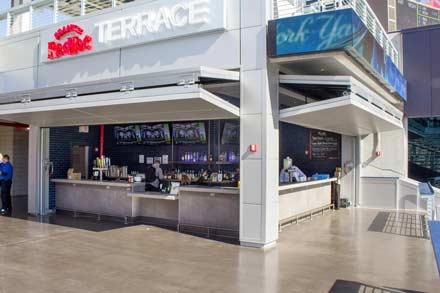
Five Schweiss bifold designer doors add to Yankee Stadium off-season enhancements
The largest of the custom-made bifold doors is 27'5” x 11'4,” followed by two 23'4”x9'2” doors and two 21'10” x 9'2” doors. All the doors are fitted with electric photo eye sensors, black liftstraps, manual latches and alike-keyed opening and closing switches. Four of the doors are clad in a high tech brushed aluminum. They finished the facade and the door to basically match itself so when the doors are down they blend in with the facade and don't reveal what's inside. |

|
Texas Music Factory looks to Schweiss for seven bifold doors
The Toyota Music Factory in Irving, Texas covers nearly 17 acres and seats 8,000 people indoors and outdoors. Seven Schweiss bifold liftstrap doors, which can be seen in the upper left of this architects rendition, were installed on the Pavilion live stage building. The doors open the concert to 4,000 overflow fans on a grass slope. |

|
Hurricane Harvey tries to mess with Schweiss doors
Hangars with Schweiss bifold doors at the Rockport, Texas Airport were virtually undamaged by Hurricane Harvey. Many others next to them were demolished beyond repair |

|
One of Tampa's oldest restaurants is revived - this time with Schweiss Bifold designer doors!
His new 4,000 sq. ft. restaurant has four glass-clad Schweiss Bifold Liftstrap designer doors. The largest of these doors is 12'5" x 7'6" tall. Two are 9'1" x 7'6" and the smallest is 6'5" x 7'6". The doors all have electric photo eye sensors, manual latches and one remote that can operate all four doors. The doors were fitted with black liftstraps and also painted with a dark green "fractured" paint old school design to give them the look of having been on the building for years. |

|
Canadian hangar developer has 11 Schweiss bifold doors
Gjesdal has a total of 11 Schweiss doors on his hangars built over the past five years. Schweiss bifold liftstrap doors, with automatic strap latches and electric photo eye sensors were placed on his two newest 100' x 167' hangars. The doors vary in width from 57'8" to 50' and in clear opening height from 16'8" to 16'. His older hangars are equipped with six Schweiss 50' x 14' cable lift doors. All these doors also have walkdoors and remote openers. He opted to receive his doorframes painted in red. |

|
Strap bifold doors are the premier choice for many hangars at the Waterloo airport
The Waterloo Regional Airport hangars in Waterloo, Iowa are leased by the city to private pilots and corporations. Three of the large hangars have jet aircraft in them; multiple planes, floatplanes, jets and helicopters are stored in other hangars throughout the airport. Two of the hangars are used as maintenance shops. |

|
Husky Brigade is off to the sky minutes after pilots hit the open button on their Schweiss doors
Kerr said that along with somewhere around 18 Husky's on the Alpine field, not counting neighboring Husky's from the Double L Ranch and other style aircraft hangared at Alpine Airpark, over 45 of the 58 residents there have Schweiss doors on their hangars each with their own personal style and size to match their mountain vacation homes. |
|
Hydraulic door added to mancave dream for helicopter and floatplane pilot
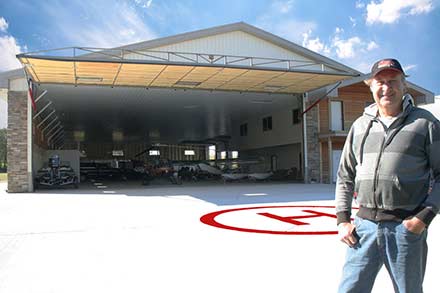
Easy access to the 11,160 sq. ft. hangar in his 80 ft x 152 ft. building is through a quiet-operating 50' x 17' 7.5" Schweiss hydraulic door. The hydraulic pump for the door is mounted out of sight above the rafters to make best use of all available space within the hangar. He also has a remote opener to enable him to open and close the door without having to leave the cockpit. Three 3.5' x 2.5' windows in the door give him optimum use of available light into the in-floor heated hangar and the hydraulic one-piece door, when open, provides a nice shaded canopy. |
|
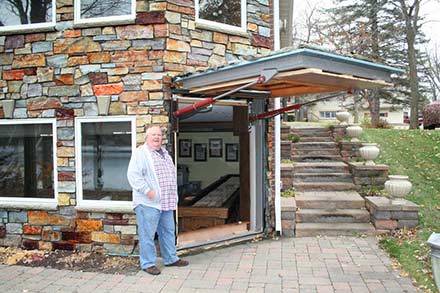
Former airline pilot chooses Schweiss hydraulics for door and lifting garage staircase
Gene Buboltz of Cold Spring, Minn. chose Schweiss Doors to install a small hydraulic door and lifting staircase on his lakehome to give him easy access to all levels of his home. As time progressed he turned this basement room into a rec. room and a place to store his flying memorabilia. |
|
RV Bifold garage door was built for performance, designed for style and meeting zoning restrictions
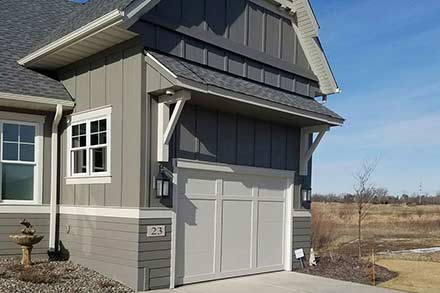
Jay Hare and his wife, Kathy, of North Oaks, a suburb of St. Paul, Minn., had to deal with zoning restrictions on their RV garage door, but with the assistance of Schweiss Doors they were able to work around them. The finished look on their 12' x 16' RV bifold autolatch liftstrap door with remote opener and photo eye sensors gives them a clear opening of 14' but gives the outward appearance of a door half that size in height. |
|
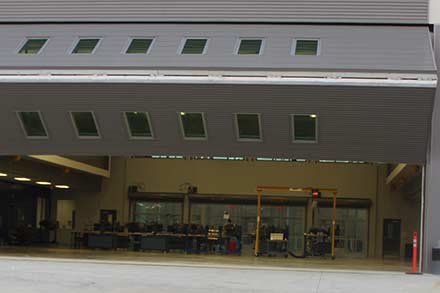
Texas aviation high school opens to new type of education with a 49' Schweiss aluminum bifold door
Ross Shaw Sterling Aviation School in Houston, Texas had this 49' 6" x 20' 2" Schweiss bifold liftstrap door placed on its new attached hangar. The custom-made aluminum frame door has galvanized windrails and siderails and a keyed switch entry system. |
|
Unique Schweiss glass bifold doors open new Kings stadium entrance
Schweiss Doors engineered and built five one of a kind bifold strap latch doors to be used at the stadium entrance. Three of these doors measured 29' x 41'5" and the other two were 29'4" x 41' 5". Each door is lifted by three 5 h.p. motors and the liftstraps are 6" width, compared to the usual 3" width. The doors, with glass, weigh in at about 28,000 lbs. each. |

|
Larry Robbins is a pilot living the dream
Like many young boys dreaming to be licensed pilots, Larry Robbins remembers at the age of six or seven scooting out the front screen door of his parents central Illinois farm house where he grew up to get an overhead glimpse of any and all planes that came within earshot. His love of aviation led him to pursuing a career as an Aeronautical Engineer and his latest job with Bojac Aviation Services. |
|
Canadian Forces military base calls on Schweiss for hydraulic and bifold doors
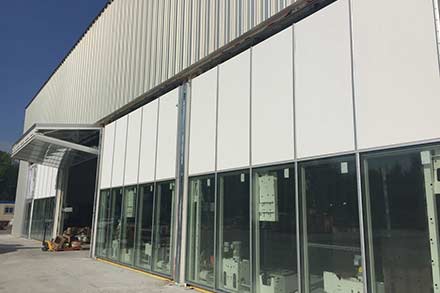
Supplying doors for military bases is nothing new for Schweiss Doors, they've been doing it for years. Although Canadian Forces Base Borden didn't have a need for specialty blastproof doors like other military establishments, a recent building expansion project for its training school called for the use of Schweiss hydraulic and bifold liftstrap doors. |
|
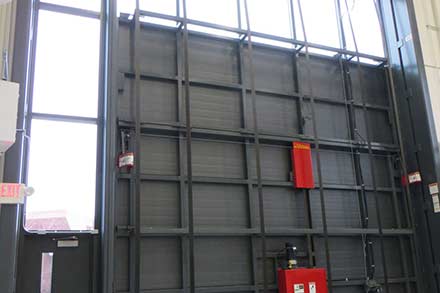
U of M physics building has clean room access with a Schweiss bifold door
Star Equipment of Blaine, MN was in charge of installing a 19' 11" x 22' 8" tall Schweiss bifold liftstrap door with automatic latches and electric photo eye sensors on the physics building. The specially designed door has a rather unique application of wide glass panels at the top that nearly surround it all the way to the man door alongside it. This allows as much natural light as possible to enter the building without it being an all-glass clad door. Strong black liftstraps and two top-drive motors open the door quickly and quietly. |

|
Federales Mexican restaurant in Chicago features a fully retractable roof and Schweiss bifold doors
Nothing says summer like tacos and tequila. Chicago’s newest sprawling Federales Tequila & Tacos restaurant and bar in the West Loop offers plenty of both. Inspired by Mexico's roadside taco joints, Federales specializes in barbacoa-style tacos, starring such slow-cooked meats as pork belly al pastor and shredded beef brisket, served with warm corn or flour tortillas and taco trimmings. It truly has a vacation atmosphere featuring a fully retractable roof and two Schweiss bifold liftstrap 14' 3" x 14' 8" designer doors that open to beer garden. |

|
Hangar with Schweiss bifold door has look of Texas flare
Who needs Europe? Fredericksburg, Texas in the Texas Hill Country, west of Austin and north of San Antonio, might be the next best thing to crossing the Atlantic. The region is lush, colorful and, unlike much of the pancake-flat state, dotted with beautiful green hills that are evocative of Tuscany or the south of France. Towns like Fredericksburg offer a taste of the Old World, with German-style biergartens, schnitzelhauser and a lot of wineries. |

|
Big 70-foot hydraulic door opens Tennessee jet hangar
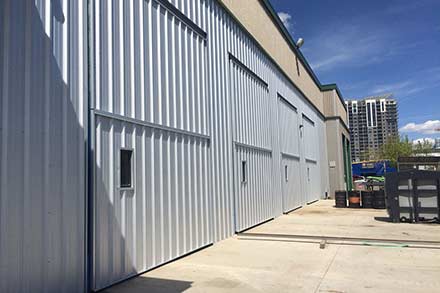
With nine locations in Tennessee and Mississippi Dr. Ron Bingham has an interesting business model requiring aircraft from his hangar in Jackson, Tennessee to visit his satellite clinics in rural areas. |
|
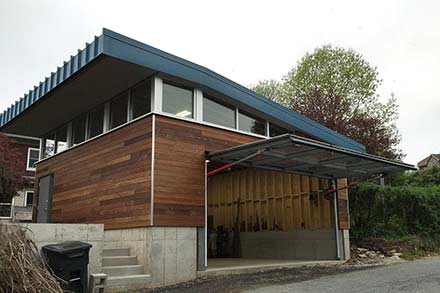
Cubex in Calgary installs eight bifold doors
Cubex Limited of Calgary, Alberta, Canada is a busy fabrication business that underwent an extensive renovation project in order to get the best use out of their building. To do this they virtually knocked out several portions of one side of the building adding eight Schweiss bifold/liftstrap doors for easy access. |
|
Pennsylvania hydraulic garage door has touch of class and a beautiful view
It's very satisfying for a business to hear from a client who mentions sincerely that he or she was equally satisfied with the service rendered as well as the product itself. It's been a highlight for Brian who says one of the best things about his new Schweiss hydraulic garage door is hearing favorable comments from people who see it. |
|
Fast Fab erects CAID Industries Mid-West Structure of the year
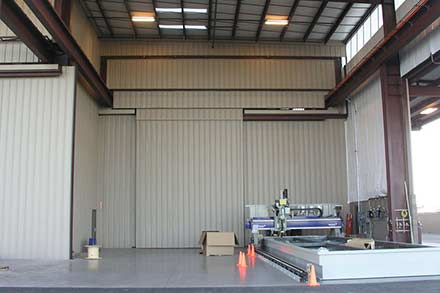
CAID Industries called on Fast Fab Erectors, Inc. of Tucson, Arizona to do the design and building work for their new Tucson, Arizona facility, featuring metal products from Mid-West Steel Building Company.Part of the construction called for two large Schweiss hydraulic crane doors. A 30-ton crane has a lot of lifting power, but in many cases, it needs a door system to effectively do its job. |
|
Glass bifold designer door serves California church expansion plans well
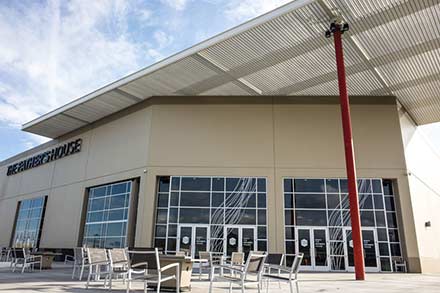
The Father's House church is listed at the top spot as one of the best 10 churches in Vacaville, California. It has shown amazing congregational and building expansion growth under the direction of founding Pastors Dave and Donna Patterson. The church was opened for worship in 1997 and has grown from a handful of families to thousands of attendees at multiple campuses in Vacaville, Napa and East Bay. The three locations are all within 40 minutes or less of each other. |
|
Southern California Institute of Architecture selects bifold glass doors for new building
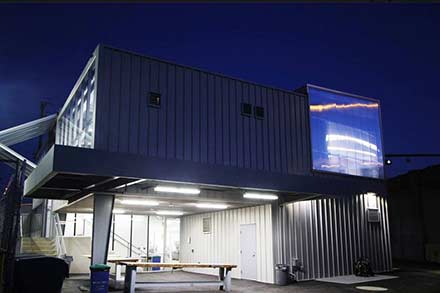
SCI-Arc in Los Angeles, California, is an independent, non-profit school offering undergraduate and graduate degrees in architecture. It offers community design and outreach programs, and free public access to frequent exhibitions and lectures by leading thinkers in architecture. Founded in 1972, SCI-Arc is widely regarded as one of the most avant-garde U.S. architecture schools, with a reputation for pushing the boundaries of academic study. |

|
Modern Winnipeg home highlighted by pine-clad bifold garage doors
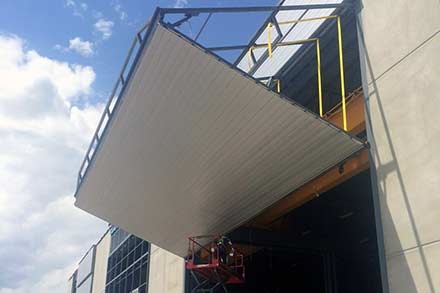
A lot of planning goes into new home construction. Tom Struthers of Winnipeg, Canada extended his attention to detail right down to his garages. The Schweiss Bifold liftstrap garage doors have an enhanced appearance utilizing a vertical pine wood exterior to highlight each of his three doors. |
|
A 'tall order' was a cinch for Equal Door Industries and Alberta E-House, Inc.
Equal Door Industries of Calgary, Alberta, Canada and Schweiss Doors have been in business for many years and together they have received custom orders for doors of all sizes. |

|
Princeton University Energy Plant has Schweiss bifold Chiller Building doors
Princeton University in New Jersey is a place where you can find a lot of very smart people, young and old. Apparently the administration relied on its research when it decided to choose top of the line Schweiss Doors for its new Energy Plant building. The Princeton Energy Plant is a district energy facility that provides electricity, steam, and chilled water to power, heat, and cool the buildings on the Princeton University campus. The creation of the plant and the continuous refinement of its operation have had a very positive impact on Princeton's carbon footprint. |
|
Barrel & Bushel restaurant and bar opens up to outside patrons with Schweiss bifold glass doors
When Barrel & Bushel, a new beer-centric restaurant at Tysons Corner, Virginia says 'Handcrafted Just for You,' they are referring to more than their location, extensive menu and beverage list, but also to the upscale surroundings in which you can enjoy a place to relax and visit. |

|
Alberta, Canada hangar shines like a brand new penny
If you think the exterior of Gary Acheson's Alberta, Canada hangar looks slick and clean, you ought to see the inside- it sparkles.
Acheson and his family who own a custom home building business, finished building their new 6,000 sq, ft, wood hangar located at the Villeneuve Airport located at St. Albert, a community of 64,000 residents about 6.5 miles (10 km) north of Edmonton in May of this year. |

|
American Institute of Architects chooses a Schweiss designer door for use in new Atlanta Headquarters
For more than 150 years the American Institute of Architects (AIA) has served as the voice of the architecture profession and a resource to its members in service to society. Chartered in 1953, AIA Georgia consists of close to 2,000 members distributed over seven local chapters. AIA serves as the voice of the architecture profession and a resource to its members. The vision of the American Institute of Architects and AIA Atlanta and Georgia is Driving Positive Change through the Power of Design. |

|
Schweiss Doors looks to MJ Kretsinger Digital Agency
The driving force behind a successful business depends a lot on marketing. Getting the word out in a clean, well understood and concise manner to potential clients that will prove from a marketing standpoint that you are a brand name company qualified to meet all their needs. The end result gives a customer the best product on the market for them to buy or recommend by word of mouth to their friends and other business acquaintances is paramount. |
|
All about doors... Big Doors
Mike Schweiss, of Hector, Minnesota, is one focused individual. Rather than devoting time and energy to a wide variety of activities and undertakings, Mike finds fulfillment in two areas of interest - doors and horses. From his point of view, everything else is pretty much a diversion. It's been that way for much of his adult life. |

|
Tennessee turntable hangar has two 48 ft. Schweiss bifold doors
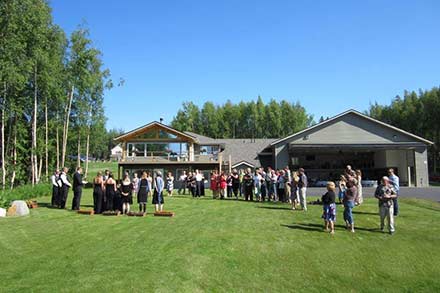
Rogers, who has instrument and multi-engine ratings and a Commercial Pilot Certificate, has been flying for over a decade and for the past five years in his Piper Malibu Matrix, said he and his wife, Connie, who earned her Private Pilot Certificate this year, wanted a vacation home getaway. They especially wanted a place where they could spend time with fellow aviators and where they could live closer to their airplane. The solution to that was building a new home at Big South Airpark located in Oneida, a town in Scott County, Tennessee, less than 10 miles from the Kentucky border. |
|
Pilot and wife live the Alaska airventure dream
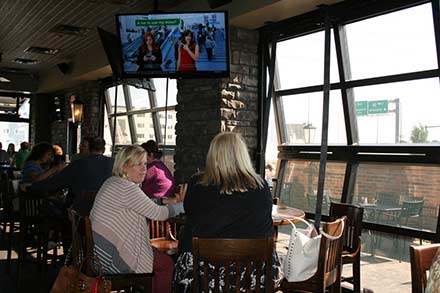
If you want to stop in for a great meal, enjoy authentic Irish atmosphere, and choose from a selection of 36 draft Irish and English beer selections you don't have to go all the way to Ireland to do so. You'll find this all at the Blarney Stone Irish Pub in West Fargo, N.D. It features a Stone Courtyard Bar area that seats 70 people with three 19'4" x 7'11" bifold glass doors that can be opened in nice weather, rain or shine. Connected to the Courtyard is a patio area that seats another 60 people. |
|
Blarney Stone Irish Pub customers of West Fargo love its three glass bifold designer doors
He currently has a 1966 Cessna 180H on big tires; a 1975 Cessna A185F on Aerocet floats in the summer and Landes Hydraulic Wheel Skis in winter; and a 1964 PA-30 Turbo Twin Comanche.He currently has a 1966 Cessna 180H on big tires; a 1975 Cessna A185F on Aerocet floats in the summer and Landes Hydraulic Wheel Skis in winter; and a 1964 PA-30 Turbo Twin Comanche. |
|
Tom Green's 'star-shaped' Michigan hangar home is designed for optimum use
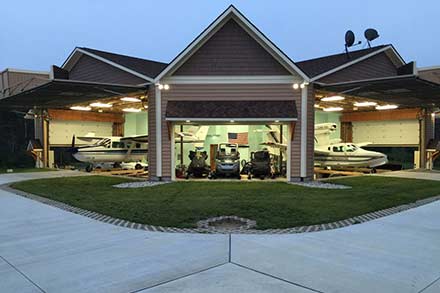
From the air you can see that Green's hangar home is shaped like a big star. Green said he likes the Schweiss hydraulic doors because they operate smoothly and open up about 90 degrees. They allow his planes to go in easily and will accept even bigger planes to enter his hangar. Green is a money manager and financial advisor for Morgan Stanley in Flint, Michigan. He flies mainly for pleasure now, but over the years used his planes for business as well. |
|
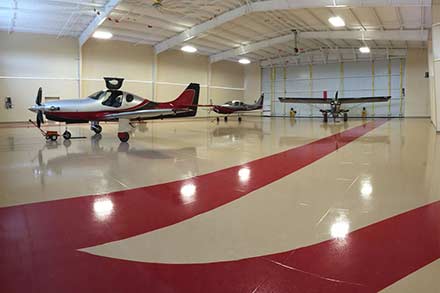
Arizona hangar has style, from the floor to the doors, and there's more to come
You probably won't see a nicer looking hangar than the one owned by Daniel Coury of Queen Creek, Arizona. He's a loyal Schweiss Door customer, who over the past year or two has ordered 13 bifold hangar doors and speculates he will be ordering 22 more in the next two years for his five-acre development holding 31 box hangars; an ongoing project at Pegasus Airpark where he now has nine hangars completed. His modern steel 80 ft. x 100 ft. insulated show hangar has two Schweiss bifold liftstrap/autolach doors; a 70 ft. x 18.6 ft and a 60 ft. x 18 ft. tall. |

|
Two more huge Schweiss bifold doors delivered at Cape Canaveral
Rocket hangar doors are not your run-of-the-mill doors; there are a lot of specialized things associated with these doors that Schweiss Doors has to conform with. Their latest orders from the Schweiss Doors factory were installed on a new steel hangar at Cape Canaveral. The largest of the two is a Bifold Liftstrap door 90 ft. wide x 61 ft. tall. The second door on that shipment is 40 ft. wide x 69 ft. tall. Each of the doors is equipped with automatic latches and are windrated to 150 mph. After they arrived at the site they were clad in 26 guage sheeting and have 4-inch blanket insulation. |
|
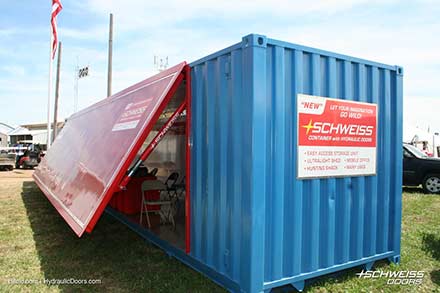
"New" Let Your Imagination Run Wild! Schweiss easy access container unit with hydraulic doors
If you need a really easy access storage unit, Schweiss Doors has the answer. These newly designed Schweiss containers are perfect for a number of uses such as safe and secure portable sheds, workshops, a mobile office, storage for farm seed and chemicals, hunting shack, band stage, food and beverage stands; it can be used for most anything you can imagine. Custom-built from the bottom up, the new Schweiss Container with hydraulic doors and specially designed cylinders for Schweiss Doors only, is unlike any other container opening system you'll run across, and it's portable. |

|
Doc B's Kitchen compares Schweiss designer door to driving a convertible
The Gold Coast location features a Schweiss one-piece hydraulic glass designer door which opens wide at the entrance to the outside where customers can also enjoy their dinners sidewalk style.
"What's unique about the door is when it's open it creates this natural canopy. You can sit right up next to the window. So if its rainy or misting outside you get the benefit of the outside visual and still have the advantage of that outdoor/indoor feel," explained Bernstein. Once I saw this door, I was attracted to it and knew it was the right fit. I fell in love with it at first sight," said Bernstein. |

|
Southwest Family Farms has visions of growth to meet 50,000 acres
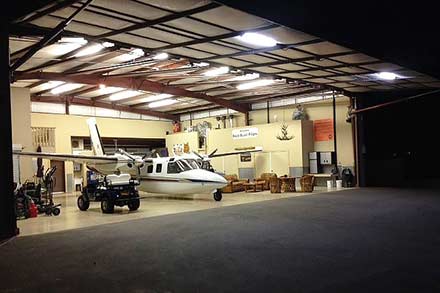
Stan Reiss got a first-hand introduction to Schweiss Doors after talking to owner Mike Schweiss at the Schweiss booth during the Oshkosh airshow in Wisconsin. He is now happy with his 54 ft. x 16 ft. one piece hydraulic Schweiss hangar door which he put on a new 60 ft. x 60 ft. steel building with 18 ft. sidewalls nearly four years ago. The door is windrated for 90 mph, has electric photo eye sensors and is equipped with an emergency drill-driven backup system and remote opener. |
|
Baja Bush Pilots guides flyers to Mexico, whale petting and more
Fly-in trips to Mexico and other destinations from Chandler, Arizona is a service offered by Jack McCormick of Baja Bush Pilots International (BPI). Since 1996 McCormick figures he has spearheaded groups of other pilots ranging from five aircraft to 117 planes on vacation destinations that normally most pilots would not try to accomplish on their own. On the average, 20-25 pilots accompany BPI on each destination that varies from three to 10 days. |
|
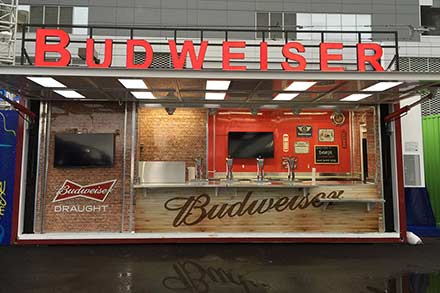
Mobile container Bar Pod makes its debut at the 'Big Game'
Bar Pods have only been in production for about a year for research and construction of prototypes. They made their debut at the Nightclub and Bar Convention last year in Las Vegas. They are a deluxe, all-inclusive, velocity service, waste reducing concession bar for beer, wine, or mixed drinks (or all three in one unit), on tap that can be adapted to customer needs. They are equipped with the TurboTap, a patented retrofit draft beer-dispensing device made from high-grade stainless steel that slips over the end of a standard U.S. beer faucet. |

|
Designer door is precise fit for Kicking Horse Ski Resort home
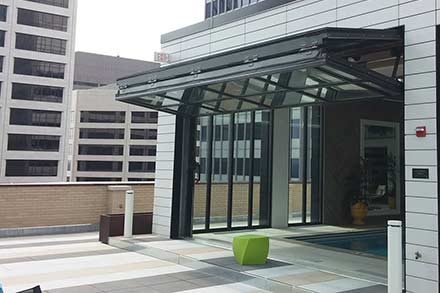
Located in one of the most beautiful places on the face of the earth, Golden is near six of the most stunning National Parks Canada has to offer; Banff, Glacier, Jasper, Kootenay, Mount Revelstoke and Yoho. This place has long been well loved and well used by explorers, and even more recently for skiers and outdoor summer and winter enthusiasts. Situated at the base of the Kicking Horse Mountain Resort in the Canadian Rocky Mountains, this 3,500-square-foot residence is a gathering place for an active family of five. |
|
High in the sky . . .
|
|
Overseas market is booming... Schweiss 93 ft. bifold goes to Poland
The large 93.9 ft. wide x 34.9 ft. tall bifold door installed on a new steel hangar was designed for Category 4 windload and heavier cladding. If was fitted with full safety features which included autolatches, strap tension sensors, top overrides, photo eye sensors, bottom safety edge and internal and external beacon/sounders. One dozen liftstraps, rated to carry 29,000 lbs. each, easily lift and lower the heavy 93.9 ft. all-steel frame 20,000 lb. door. |

|
Architect revamps his old wood hangar
If architecture is your vocation, why not use your skills to revamp your own hangar? That's what Dennis Yates, AIA, of YCH Architects in Concord, North Carolina decided to do when time came for it to get a new door in place. His dual purpose 40 x 60 ft hangar/storage building is big enough to house two planes with room to spare for a workshop and general-use storage for his practice. A strong Schweiss hydraulic 39 ft. x 11 ft. 4.75" custom made door is mounted to a reinforced door surround that is about 48 ft. wide at the front. |
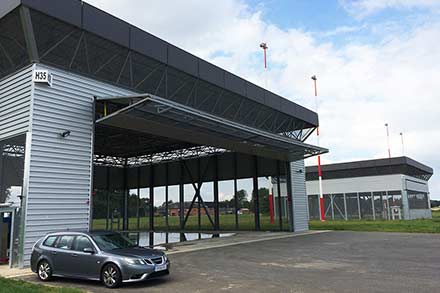
|
Belgian military looks to Schweiss Doors Europe for dependable bifold doors
When Belgian Airforce military personnel at Aerodrome Beauvechain needed reliable doors for their new helicopter hangars they went with the quality bifold straplift door offered by Schweiss Doors Europe in the UK. "It was a great honour to have been chosen to supply these doors to the Belgian military; they are the first Schweiss Europe has installed in Belgium despite installing hundreds of doors throughout the EU," said David Naylor, owner of Schweiss Doors Europe. |
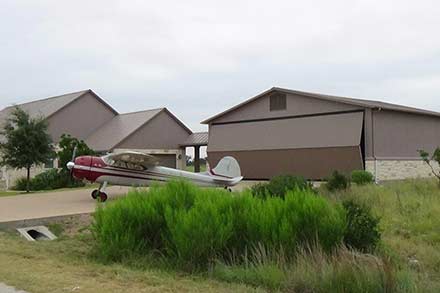
|
Overheard compliment convinces Texas hangar owner to go Strap Bifold
Hower ordered a 45 ft. 11 inch x 14 ft. 11 inch Schweiss bifold liftstrap hangar door which gives him a 12 ft. 5 inch clear opening height for his Cessna 195. He learned about Schweiss bifold and hydraulic doors through various publications, but while at the Oshkosh Air Show he overheard another person comment on how he liked his Schweiss bifold liftstrap door. "The strap system is simply the only way to go and the best system by far," said Hower, a retired dentist. "I heard a man at Oshkosh tell your agent that he loved his liftstrap door. That influenced my decision. |
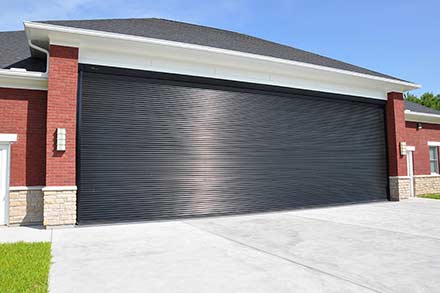
|
Beautiful Ohio airpark hangar accented by recessed bifold door
JT Strange and his family are in the process of building their new home alongside their just finished hangar in the Obannon Creek Aerodrome Airpark located in Goshen, Ohio. The newly-built hangar needed a big 45 ft. x 15 ft. 11" door for his Cessna 182T, which he also uses for business in nearby Milford, Ohio. |
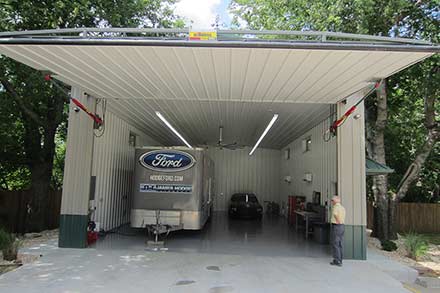
|
Dentist with a drag car likes sleek look of his Schweiss hydraulic door
You might say that Dr. Michael Stephens, a dentist since 1968 in Muskogee, Oklahoma, is enjoying the twilight of his profession. He also makes the most of his time off hobby hitting the race track. Racing is normally known as a young man's game, but Stephens, age 72, says he slowed down to get into a faster mode of racing - drag racing. |

|
No more wrestling with slider doors for this Washington hangar home
John Stasny of Silverdale, Washington decided awhile back that he had enough of the four sliding doors on his hangar home. After a bunch of research, which included checking out door manufacturers, periodicals and talking to other pilots and friends he decided a Schweiss hydraulic one piece door was the only way to go. |
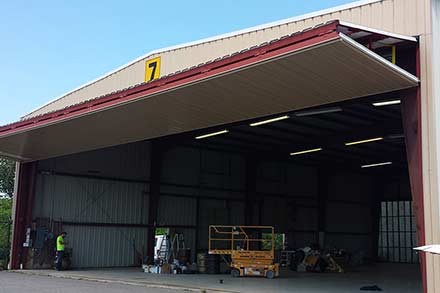
|
Maine contractor chooses Schweiss doors for New England and beyond
Irishspan Industries of Alfred, Maine bills itself as New England's Quality Source of Steel Buildings. They are fast becoming a prime installer and promoter of Schweiss hydraulic and bifold liftstrap doors as well. [Their] most recent project was modifying an existing steel hangar for Marine Home Center of Nantucket, Mass to accommodate a large Schweiss straplift bifold door. |
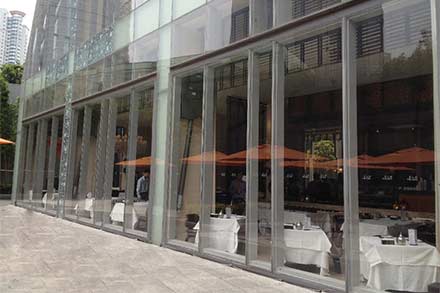
|
Schweiss Hydraulic Designer Doors make their debut at elegant China hotel
The architect and a project coordinator from China assigned to this lavish hotel wanted to see firsthand the workings of Schweiss Doors, so they boarded a plane in the middle of the winter to tour the Minnesota factory where their three doors were built. What they saw here, along with the information provided on the Schweiss website, reaffirmed them without a doubt that Schweiss Doors craftsmanship was up to their stringent standards. |
|
Italian senior designer visits Schweiss Doors seeking insight on bifold door designs for renowned Prado Museum of Art
Fabio De Ciechi and Schweiss Doors draftsman, Brent Krzmarzick, discuss AutoCAD paper engineering door drafts for the Prado Museum in Madrid, Spain. |
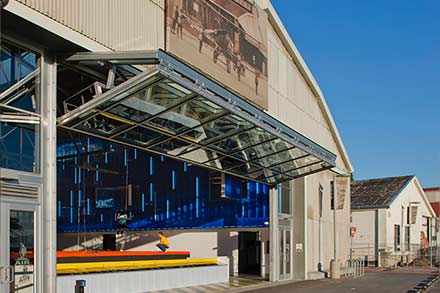
|
House of Air gives flight to the flightless; bifold door gives open air to the hangar
House of Air is an indoor trampoline park located in a historic airplane hangar at West Crissy Field in the Presidio of San Francisco, California, not far from the Golden Gate Bridge. What used to house high-flying aircraft, now houses hundreds of energetic youth-minded people, some of whom can now exercise a different style of high flight. |

|
All Inside Storage hangs 130 Schweiss Bifold Doors
There's nothing much more frustrating than when you discover someone scratched or rubbed against your vehicle or aircraft because it was parked too close to another while in storage. This is what John Obradovich, owner of All Inside Storage of Indio, California, describes as "Hangar Rash." |
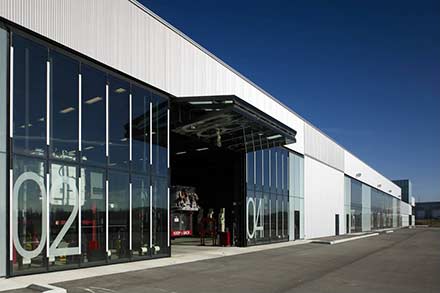
|
Environmental design of Ontario Operations Centre has 20 Schweiss 'green' doors
Newmarket, Ontario, Canada is a 80,000 population town projected to grow to approximately 98,000 by 2026. Located north of the city of Toronto, it is part of the York Region and Golden Horseshoe of Southern Ontario. Due to these growing pains Newmarket was overdue for a new municipal operations building. For many years, the town of Newmarket's Public Works Services, including operations (water, roads, snow removal) and parks and property maintenance, had been operating out of three buildings at two existing facilities for years. |
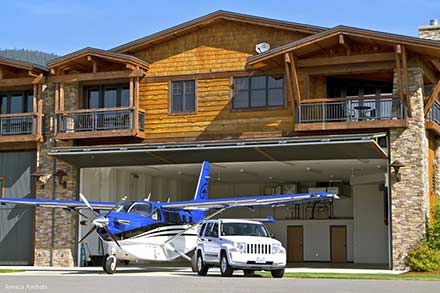
|
SilverWing at Sandpoint offers the very best in airpark living
Such is the case at SilverWing at Sandpoint. This unique fly-in airpark community, set between Schweitzer Ski Mountain and Lake Pend Oreille, one of the West's largest lakes in northern Idaho, spans over 18 acres adjacent to the Sandpoint, Idaho public airport. This airpark has been in development since land was purchased in 2007. Now, several years later, the airpark is ready for people to move in. |

|
Maine EAA Chapter gathers forces to build a new hangar
Active organizations have a way of getting things done - done on time, done on budget and done with the help of individuals and the community they live in. The worldwide Experimental Aircraft Association (EAA) has EAA Chapter 1210 of Biddeford, Maine in its ranks. Although relatively small they are non-the-less definitely an active "get it done" organization. |

|
Canadian waters-edge floatplane and boat hangar door opens up to the great outdoors
Dryden, Ontario, Canada, is where the rugged beauty of Ontario meets the bright lights of city life. It is a vibrant urban community surrounded by the unsurpassed beauty of the boreal forest, freshwater lakes and spectacular vistas. The settlement was founded as an agricultural community by John Dryden, Ontario's Minister of Agriculture in 1895. |

|
Aviation Experts in France rely on Schweiss Doors
Aviation Experts SARL is an established 15-year-old French aviation maintenance business and aerial photo survey and mapping business that services not only France and Europe but is called out to far reaching overseas locations. Its hangar and base of operations is located in Nangis, a 7,500 population commune in the Seine-et-Marne department in the Île-de-France north-central region of France, approximately an hours drive south of Paris. |
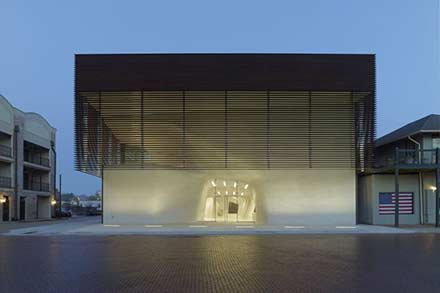
|
Schweiss hydraulic doors inducted into Louisiana Hall of Fame
The headline is a bit ambiguous, but it sure sounds good. In all actuality, there really are Schweiss Hydraulic one piece doors on the Louisiana Sports Hall of Fame - they were installed there, not formally inducted, and are for functional applications, not for sporting accolades. Just the same it's still an honor for them to be in this new and long awaited sports complex where visitors from all over the world come to pay homage to their Louisiana... |
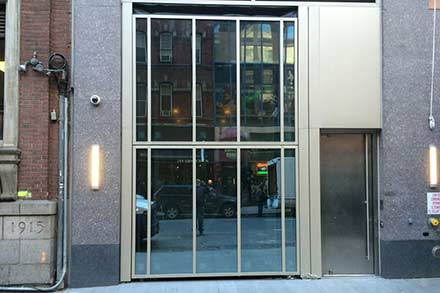
|
Schweiss glass bifold door goes on exclusive New York Lexington Avenue hotel
Schweiss designer doors have gone on numerous exclusive hotels stretching from China to Europe. The latest to join this elite group is the Club Quarters Grand Central Hotel on Lexington Avenue, downtown New York City. |
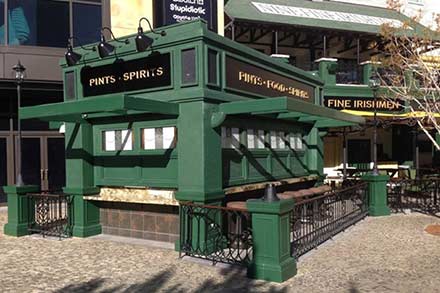
|
Las Vegas Irish Pub features Schweiss designer doors on its outdoor patio bar
Words on the Nine Fine Irishmen pub website point out: "We Didn't Just Import Irish - We Imported The Whole Damn Country." Inspired by a group of nine famous men who fought for Irish independence, to some, they were patriotic heroes. To others, traitorous rebels. But, on to the story... |

|
Monster Schweiss doors open up for Ohio National Super Stock Champion
A 60 ft. bifold door isn't the biggest door by far ever built by Schweiss Doors, but just the same it's one heck of a big door. Shane Kellogg of Forest, Ohio needed a big door like this on his farm plus three other 40 ft. doors to store his farm equipment and his award winning pulling truck and semi that he uses to haul it to shows. |
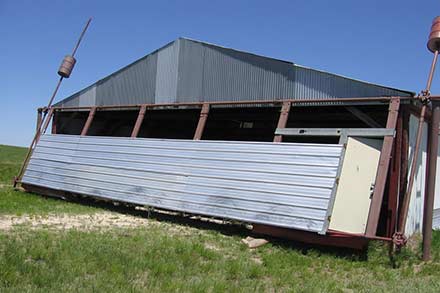
|
Most everything starts from something.... The Evolution of the One-Piece Door
Bifold doors keep getting better thanks to Schweiss Doors. With proven Lift Straps and Auto Latches the door travels up faster and smoother. Say no to cables! Schweiss Patented Lifts Straps are the latest and greatest improvements to bifold doors that have been around for years... Bifold Doors just keep getting Better! |
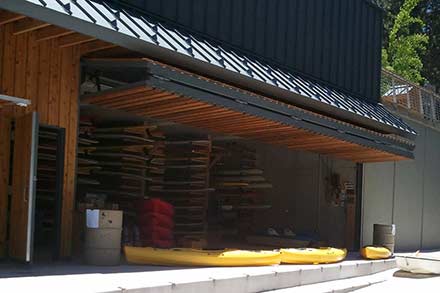
|
Lake Tahoe beachfront watercraft rental buisness calls for Schweiss Door
Schweiss boathouse doors have a reputation of showing up at some of the most beautiful lakes in America, but perhaps the most beautiful of them all is the 989 ft. deep Lake Tahoe which borders Nevada and California. |

|
Born to Fly - The Rest is History
What you see at the David Burroughs fourth generation farm north of El Paso, Illinois, located halfway between Cedar Rapids, Iowa and Chicago, isn't your run of the mill ordinary hangar - it has class, inside and out. |
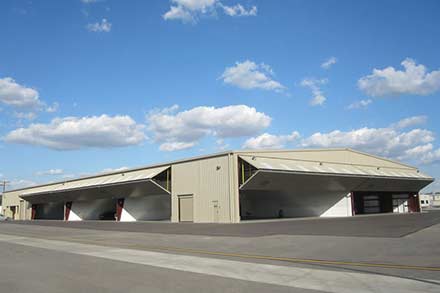
|
Continental Design Build puts five Schweiss bifold doors on California Executive hangars
They're long and sleek - over 60 foot long and stand 21.6 feet tall - big enough to open up for most any corporate prop or jet aircraft. Five Schweiss straplift bifold doors completed a summer order from Continental Design Build (CDBI) in Anaheim, California for new executive steel hangars they were building in Fullerton, California. |
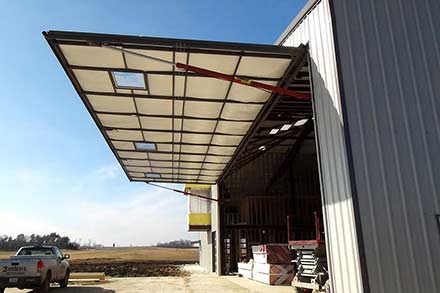
|
Skydive Midwest operations begin and end at the hangar
The fun part of Skydive Midwest's operation mostly takes place the minute you go airborne to the time you step out of the jump plane and then safely land on terra firma. That's mainly what the jumpers look forward to, however there are many behind the scenes tasks that begin and end at the all-important hangar. The hangar, a place to pack parachutes, check weather and park planes; most airports can't get along without one, and wouldn't want to. |

|
The Door's Wide Open at Fagen Fighters WWII Museum
If your heart is into aviation, and you have money, there is no end as to what you can accomplish, including building a first-class aviation museum, and filling it with some of the finest examples of World War II aircraft. That's what ethanol entrepreneur, Ron Fagen, did in his hometown of Granite Falls, Minnesota. The museum is located at Granite Falls Municipal Airport/Lenzen-Roe Memorial Field (KGDB). |
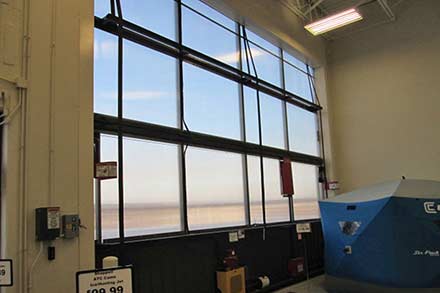
|
Schweiss Bifold Doors go on newest Mills Fleet Farm store in Ankeny, Iowa
Mills Fleet Farm, founded in 1955 by the Mills family, is a growing company with a retail chain of 34 stores in Minnesota, North Dakota, Wisconsin and Iowa. It's newest store recently celebrated its grand opening July 29, at Ankeny, Iowa - a midstate location of approximately 45,000 residents located along Interstate 35 and U.S. Route 69 approximately 10 miles north of downtown Des Moines bordering on an agricultural and suburban-based economy. |
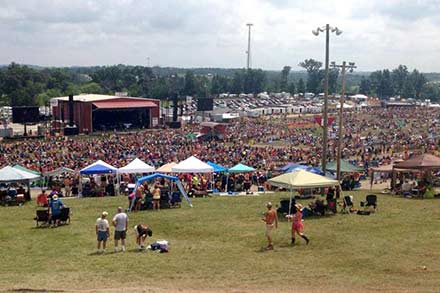
|
Jamboree In The Hills stage rocks with a 80 ft. Schweiss Bifold door
For over 36 years, over 100,000 fans each year have flocked to the rolling hills of eastern Ohio to take part in the longest running and most popular country music festival in America. This "Country Music Capital" has hosted most of the big names coming out of Nashville and other parts of the USA. Close to 25 Country legends each year such as Merle Haggard, Reba McEntire, George Jones, Tammy Wynette, Loretta Lynn, Conway Twitty, Lynyrd Skynyrd, Boxcar Willie, and even The Beach Boys and ZZ Top, you name it, have taken to the stage there. |
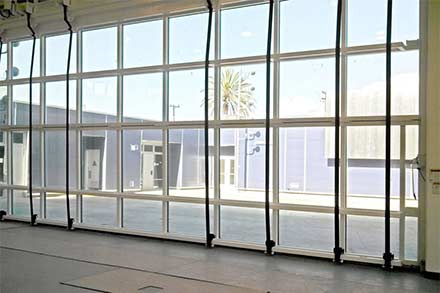
|
California's Edison Language Academy goes to school with a Schweiss Bifold glass door.
The school doors are open at Edison Language Academy in Santa Monica, California. What's different at this school is not all the doors are the same, and that goes for its unique curriculum as well. Edison Language Academy is a bilingual magnet school that is one of only 10 dual-immersion K-12 programs in the United States. |
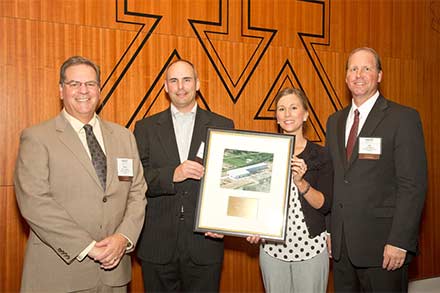
|
Greystone Construction is national award winner
Since Greystone Construction Company of Shakopee, Minnesota was formed in 1987, earning and receiving awards has been nothing new for them - their list of national and state awards for excellence, performance and merit are enough to decorate a large office or trophy room. |
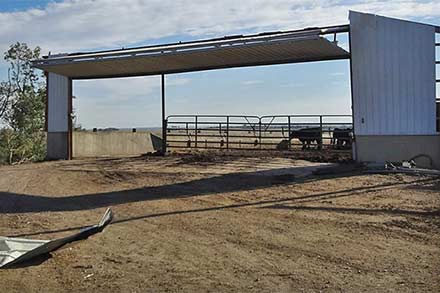
|
'Your doors stood the test of time,' says Iowa rancher hit by tornado
When daylight hit after the evening of Oct. 4, people living and working at the Triple U Ranch in Washta, Iowa, got an eyeful of destruction. It was on that Friday that Mother Nature decided to reorganize the countryside. Brad Utesch, who farms 2,500 acres and produces 6,000 head of cattle a year, with his brothers Craig and Kirk were faced with a massive cleanup after what more than likely was a tornado set down... |
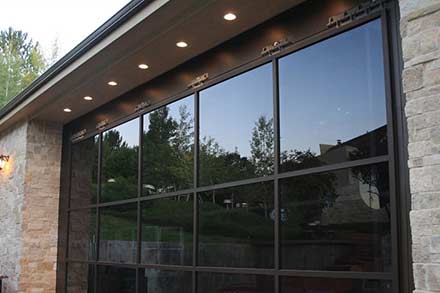
|
Glass adds a reflective touch of class to Denver contractors residential garage door
At certain times of the day the glass on Bruce Hamon's garage door reflects the beautiful Denver surroundings he lives in. While it allows others to see within, the big advantage is it allows him to see out as if looking through a picture window inside his home. And it adds a real touch of class to his residential property. |

|
California bike transit station utilizes three Schweiss glass designer doors
Who you gonna call when you need three top of the line glass bifold straplift doors for a bike transit station in California? You have two choices. You can go directly to Schweiss Doors in Minnesota or call a company that sells and installs Schweiss Doors. That would be McKendry Door Sales & Service of Santa Fe Springs. |
|
Schweiss Doors adds style to spicy new Sway Thai restaurant in Austin, Texas
Traditional Thai food has a reputation of being very spicy and hot enough to satisfy anyones taste for heat. A newly opened restaurant in Austin, Texas does that and more. Austin is a city of big flavors, but interestingly enough there are few that specialize in Thai food. That's where the long-awaited Thai Restaurant called "Sway," (meaning elevated, delicious) tops the bill. |
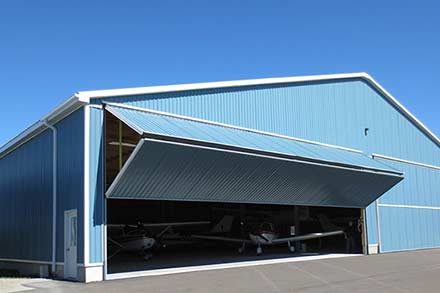
|
Billy Bishop Airport gets its first Schweiss Doors
Fame is where you find it and in many cases others try to feed off it. Such is the case with The Owen Sound, Ontario, Canada Regional Airport, named after revered World War I flying ace William Avery "Billy" Bishop. Their hometown hero was the most highly decorated Canadian pilot of that war with 72 air victories to his credit. |
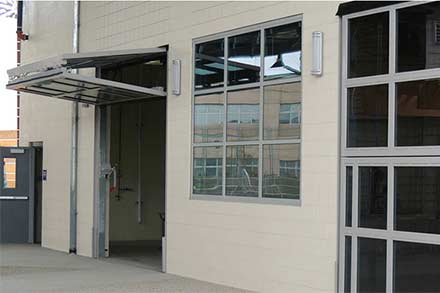
|
Door adds sparkle to unique Scripps Ranch High School in San Diego
The administration at Scripps Ranch High School in San Diego, California, with the assistance of Casco Equipment Corporation and its assigned architects, knew exactly what they wanted in the four designer doors they ordered for their school. They wanted something that conformed to "green" standards and that would serve a useful classroom function as well. |
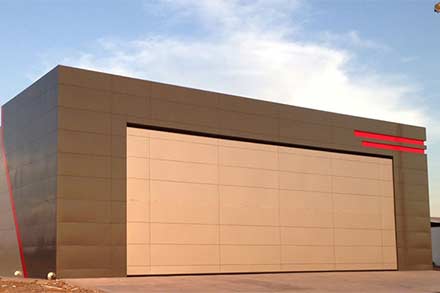
|
Schweiss hangar door shines like a big light on corporate hangar in Mexico
Ciudad Obregon is the second largest city in the northern Mexican state of Sonora. It is a historic and beautiful city of 405,000 population located near the Gulf of California about 395 miles north of Mazatlan and 400 miles straight south of Tucson, Arizona |
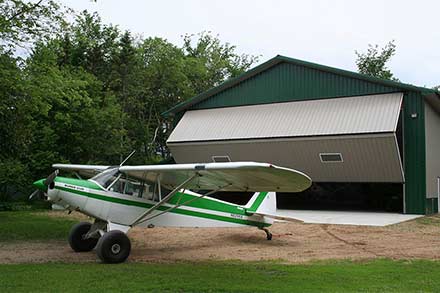
|
Rural pilot has nothing but praise for his three Schweiss Bifold doors
Gene Fuchs, 81, has been taking to the air since the age of 15 and bought his first airplane four years later. He has two Schweiss Bifold hangars doors and one large 45 ft. bifold machine shed door at his farmsite east of Morgan, Minnesota. He bought his first bifold door in the 1980s and hasn't had a lick of trouble with any of them. |
|
Now you see it, Now you don't. Crazy Cool garage door appears only half as big as it really is
Washington resident Herb Korthuis needed a tall garage door to fit his large motorhome into. A city zoning ordinance said he couldn't do it at first, but thanks to Schweiss Doors he now has a 16x12 ft. bifold door that blends into the rest of his house and neighborhood and which was OK'd by the building inspector despite its size. |
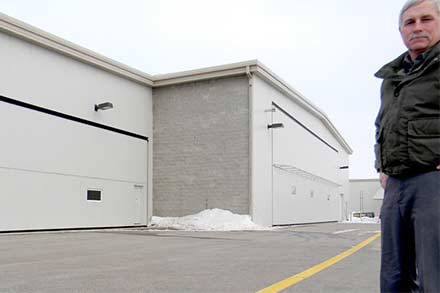
|
COMPOSITE FOAM PANELS TAKE KIEHM CONSTRUCTION NATIONWIDE
Back in 1980, Marty Kiehm, age 23 at the time, built his first structure, a 70' x 100' hangar with a 48' bifold hangar door at the Delavan, MN airport. Though not yet a licensed pilot, aviation blood was already trickling through his veins. His dad was an aerial applicator so 'flight talk' was a fairly routine part of family conversations. However following in his Dad's footprint wasn't his ambition. |
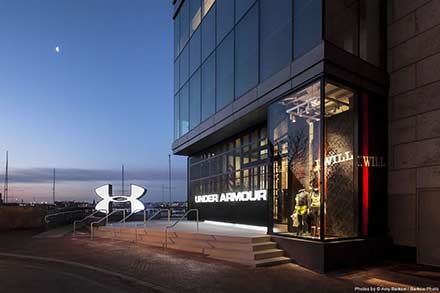
|
Top of the Line Schweiss Hydraulic Designer Door graces Under Armour building
Schweiss Designer Doors don't get much better than this. Under Armour Corporation in Baltimore, Maryland ordered this very attractive and unique metal perforated hydraulic one-piece canopy door as a showpiece for their store and office building in Baltimore, Maryland . The 28' 10" wide x 12' - 140 mph windrated door features two distinctly lighted Under Armour billboard-style logos which can be seen for miles around. |
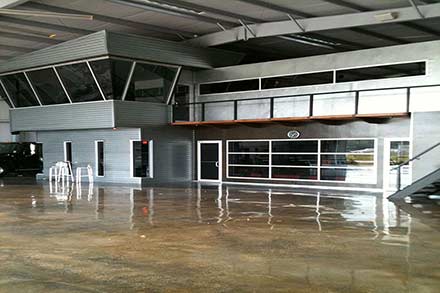
|
One of a kind Texas hangar has its own control tower
"I come here every morning at 6 a.m. I spend all day here and I enjoy every minute of it." Those words from Patrick Aucoin, Aucoin and Associates, Inc., Spring, TX. And where he comes each day is to an 84' x 84' steel hangar at the Spring, TX airfield. But what a hangar! For 14 years this spot was only a concrete slab, the only remnant from a Texas tornado that wiped out the hangar which used to set on this hunk of concrete. But not so today. |

|
Pilots are appreciating the 80 schweiss liftstrap bifold hangar doors at Oshawa, Ontario airport
There aren't many airports in the U.S. or abroad that have as many Schweiss Bifold Liftstrap/Autolatch hangar doors as the Oshawa, Ontario, Canada airport. In a three-phase project a total of 80 Schweiss liftstrap and autolatch bifold doors have been put onto hangars there. In just the last order alone, 34 Schweiss bifold doors ranging in size from 41.5 ft wide to 47 ft. wide gives some solid proof of their popularity among hangar owners there. |
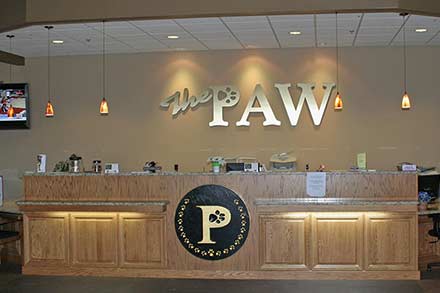
|
Innovative Schweiss lift gate gives versatility to 'The Paw'
Contemplate this description of a popular Mankato, Minnesota facility: Daycare, rehabilitation, grooming spa, spacious suites with in-floor heat, raised beds, exercise program, pool, reservations required, therapeutic laser class treatments, post operative care, hydrotherapy, kindergarten, parties and social activities. |

|
Big bifold glass door connects spaces at new Red Bull headquarters
Extreme sports enthusiasts are a key demographic for energy drink makers, and Red Bull's new North American headquarters in Santa Monica, CA was created with that audience in mind. Among the 105,000 sq. ft. buildings many impressive design features are 40' wide by 250' long, non-functioning skateboard platform and 28' tall by 40' wide, Schweiss glass-paneled bifold door. |
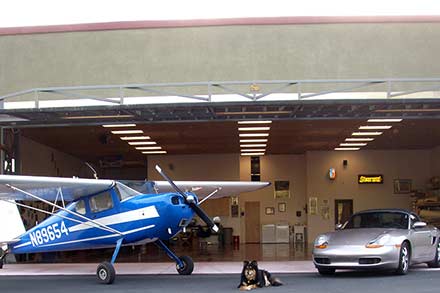
|
Arizona Stucco hydraulic door gives shade on hot days.
Aircraft enthusiasts from more than 70 nations go to the world famous Oshkosh Air Show with their eyes to the sky. It brings in more than 10,000 aircraft and displays nearly 2,500 aircraft of all makes and sizes. Dave Sirota, President of Bassuk Brothers Property Management firm in Oro Valley, Arizona, a bedroom community adjacent to Tucson, didn't go there to look at aircraft, he had another mission in mind. |
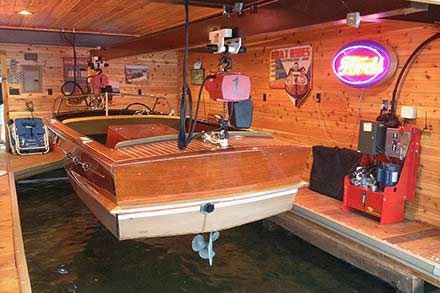
|
Schweiss Doors makes boathouse owner envy of beautiful Lake Vermilion
Schweiss Doors can't take all the credit for the envy. Ryan also goes first class with the 1955 Chris Craft Continental boat that cruises in and out of his boathouse. And for those not living on this lake, known worldwide as Lake Vermilion, that's also envious. |

|
Aero Country East is a Dallas, Texas area first-class aviation lifestyle community
"New North Dallas, Teaxs Aero Country East airpark goes exclusively with Schweiss "Red Power" hydraulic one-piece hangar doors. Many Country Club amenities and 39 custom townhomes and pool on privately-owned airport add first class appeal for pilots and families |

|
Washington Wallaby Ranch chooses Schweiss doors for its hangars
When you think of wallabies and kangaroos the first thing that comes to mind is Australia, "The Land Down Under." You don't have to travel that far, however, to see these marsupials, The Fall City Wallaby Ranch has 19. |
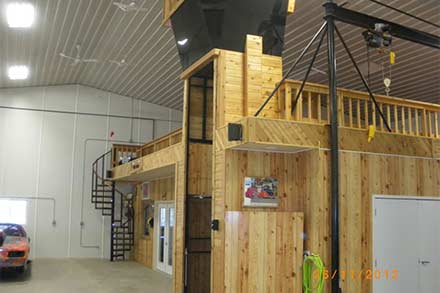
|
Kansas farmers Mancave has room for dragstrip racing cars and more
The term "mancave" has in recent times entered the American vernacular. It refers to a place where the guys can get together, lay back and talk about whatever is on their minds and solve the world problems and such over a cold one or two. Mancaves seem to be quite popular amongst football fans. |

|
Schweiss Doors installs 132 liftstrap Bifold T-Hangar doors for Bult Airfield
Only about 30 miles due south of downtown Chicago and surrounded by fields of corn, soybeans, wildlife habitat and even a few tree farms sits one of the newer and more intriguing airfields in America. Called Bult Field Airport and identified as C56, this country airport however dates back to 1942 when Paul Sanger, a Monee, Illinois aviation enthusiast started his 'grass strip' air field three nautical miles southeast of town. |
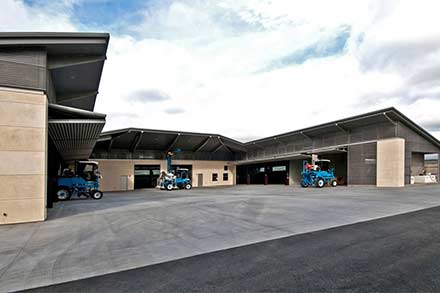
|
Napa Valley Winery puts Schweiss doors to special use
That's how Opus One building's architect, Scott Johnson, described this California Napa Valley winery located between St. Helena and Napa, almost straight north of San Francisco, California. Johnson was part of the design team behind the whole footprint of the Opus One building expansion. The suggestion and actual design of the unique Schweiss bifold and hydraulic doors was recommended by Wayne Leong, of Leong Architectural firm in St Helena, CA. |

|
Prestige Contractors of Canada is newest Schweiss Doors distributer
Most every contractor at heart wants to do the best job for their customer. Sometimes that means going above and beyond the call and at other times being able to offer the best product for them. |
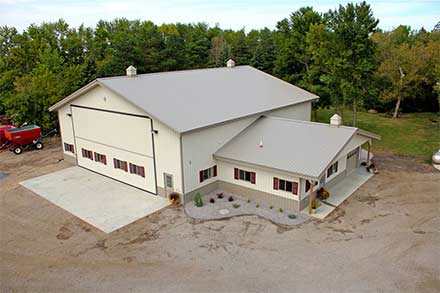
|
Large Schweiss Bifold Liftstrap door perfectly fits farmshop needs
There's nothing cheap about building anymore but this project turned out wonderfully. The Schweiss door fits perfectly. We dressed up the shop and office area with some window shutter trim. Structural Building out of Becker, MN was the contractor and they did a great job |
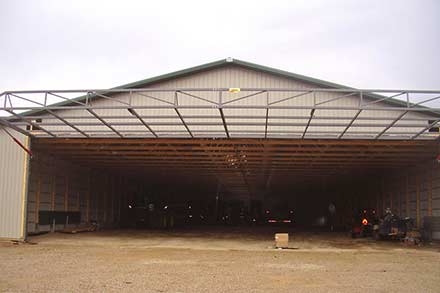
|
Inadequate experience with another company leads farmer to Schweiss Doors
It was a 70 ft. hydraulic door, very lightly built, it came in two sections that didn't meet together when they put it together. It showed up bent, and when raised it would bend, very poor weld quality, with welds missing in places. It was a piece of crap, I've never seen something so poor, there was no engineering done on it. There was no quality control. |

|
Schweiss Red Power Pumps are a jump above the rest
Jumping over the best |

|
RiverEdge Park & Music Garden orders Schweiss Doors for new Illinois project
RiverEdge Park and Music Garden is a venue that not many people in the United States have heard of yet, but they will. It is becoming the centerpiece in a 10-year master plan for the city of Aurora, Illinois, that state's second largest city with a population of close to 200,000 people, making it the 112th largest city in the United States. Aurora is located about 45 miles west of Chicago and is accessible by commuter train from there. |
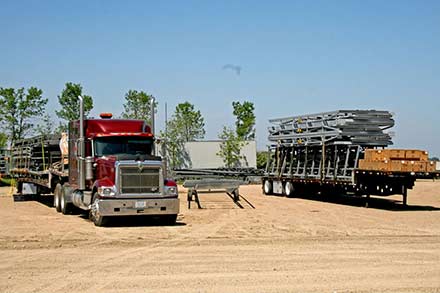
|
Schweiss has truckloads of top quality doors leaving the factory each week
Since Introducing "Red Power" Hydraulic Doors to the market this Spring, sales of Schweiss Hydraulic Doors have escalated, and as a result truckload-after-truckload of ready to assemble doors have been moving out to destinations within all corners of the United States and other locations around the globe. |
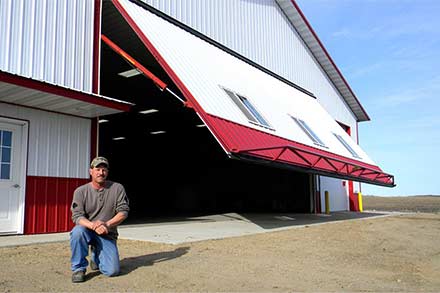
|
Sharp looking farm shop features office space and large hydraulic door
This eye catching farm shop is indeed a beautiful facility. All four exterior steel walls are white, however red is the accent color around the edges of this big hydraulic door, all windows in the door, plus other access doors into this incredible building. |
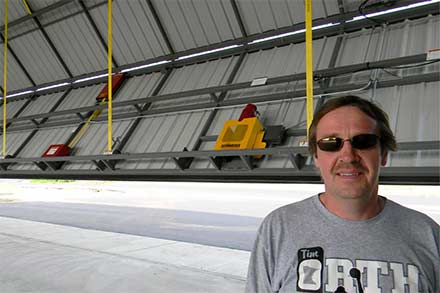
|
Taxi-through hangar speeds crop work for big time spraying operation
Twenty-seven years as an aerial applicator provides an historical perspective each spring for Rich Sigurdson, Olivia, MN. For cantankerous 2011 he simply responded,"This spring brought in a little more work than normal. This is the latest for putting crops in the ground since I've been in the business. |

|
Huge Army tanks and track vehicles pass through Ft. Carson liftstrap bifold doors
Getting 146 doors installed at one location speaks rather strongly about the quality and reliability of your door provider. But that's the current scorecard of Schweiss BiFold doors at Fort Carson, Colorado (Colorado Springs) where Mortenson Construction (Denver branch) has an ongoing contract with the U.S. Army for the construction of special heated maintenance shops called TEMFs (Tactical Equipment Maintenance Facilities). This means structures big enough for Army tanks and other special military tactical vehicles. |
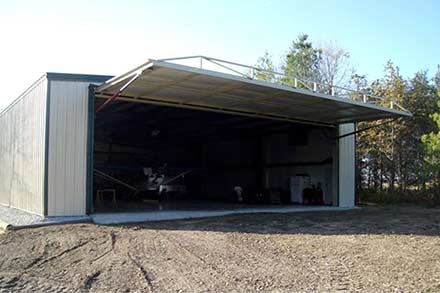
|
Electrical engineer researches and chooses 40 ft. Hydraulic Hangar Door
I researched over a year what I wanted to do. I met Dave Schweiss at the Florida 'Fun in the Sun' air show and both Dave and Mike at the big Oshgosh, WS show. After meeting the guys and looking more closely at their product the choice was obvious. It simply was the best fit, the best design, the best door and in terms of value, the best deal. |

|
Fagen WWII museum purchases multiple large Schweiss Liftstrap Bifold Hangar Doors
Here are some shots of Fagen's warbirds. All mighty nice, mint condition airplanes! Just one of many unique planes that will be on display in the New Fagen Museum. It'll be the hot spot in Granite Falls, Minnesota to see some of the most beautiful Flying machines imaginable. |
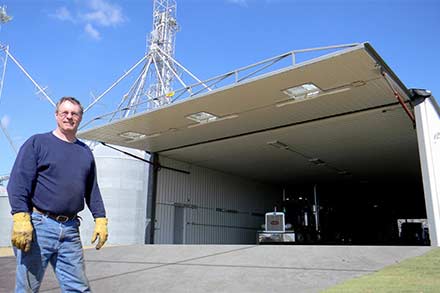
|
Fast opening Schweiss hydraulic heated shop doors were just what this farmer needed
Obviously a guy doesn't spend several thousand dollars for a big hydraulic door because it opens and closes in 37 seconds. But surprisingly 'door speed' is a bit of a factor, at least for Terry Albright, Renville County farmer who also runs a fleet of 'over the road' semi rigs. |
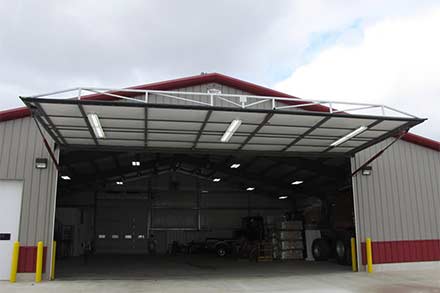
|
New 75 ft. Ohio farm shop has Schweiss hydraulic door with special lighting
A slick, new 75' x 80' farm shop with special lighting, in-floor heating, a huge 40' door and a burgundy and beige color scheme is getting all sorts of attention on the farm of John Dulin, Kenton, Ohio. "The contractor that sold me the building has people coming here every week it seems to check out the building and especially that big hydraulic door. So it's a real treat for me and my farming partner son Dana, to show them the works," explained Dulin, who is also maintenance manager for six school buses in their local special education district. |
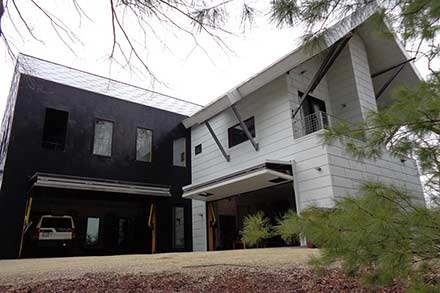
|
Wayzata resident loves his worry free liftstrap garage door conversion
Two bifold doors were on his Wayzata, Minn. home when he and his wife, Nancy, purchased it from a previous owner several years ago. He referred to the doors as "a bonus and attractive feature" and believed the architect chose the bifold style of doors for aesthetic reasons. |
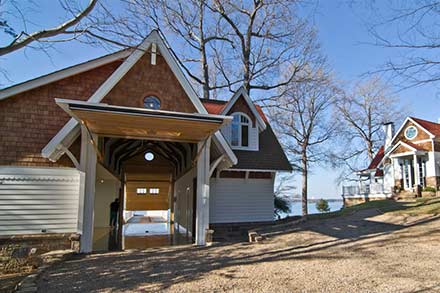
|
Carriage House helicopter hangar is very likely the most unique in America!
The Carriage House on the lakeshore property of Sid Morris, Cornelius, NC is very likely the most unique in America! It doesn't house horses and horse buggies. It doesn't house antique autos. Instead it houses his R44 helicopter. And that chopper gets to the Carriage House by first landing on a helio pad on the end of his 200' dock. A small electrically driven dolly then gently lifts the chopper with operator then guiding the chopper to its proper stall inside this remarkable 4-star carriage house. |

|
Artists architectural glass door was perfect for Martha's Vineyard studio and guest house
At 27 years of age, film maker/artist/author Travis Wood appears to be adding architectural design to his intriguing resume. Evidence of this new dimension is a most unique structure, a combination studio/guest house that he and his father are constructing on their vacation property on Martha's Vineyard, hugging the south shore of Massachusetts. |

|
Funky Brooklyn Store Front Perforated Steel Bifold Doors add touch of class and security
Hugging the southwest corner of Long Island, New York, Brooklyn's earlier identity was mostly hitched to Coney Island beach and the Brooklyn Dodgers of baseball immortality. Today the city is enjoying a renaissance of rediscovery by artists, retailers, ambitious contractors and creative landscapers including the Andre Kikoski Architect firm which just wrapped up the complete renovation of two empty, abandoned warehouse buildings on 22-28 Wyckoff Ave. |

|
Multiple stores and doors are key to Arnold Company farm implement business expansion
Consolidation is that aggressive word which has been enveloping agricultural business for several years now. In simple terms, it results in fewer but bigger. And that certainly is the recent history of the farm implement business, which used to pride itself on having eight, 10, even 12 or more dealerships per county. Today three or four farm equipment dealers per county is more the usual. But ownership of farm implement stores today often includes multiple locations throughout an entire state. |

|
Former Alaskan has Bifold hangar doors for fishing and flying from private airstrip
Flying since he got the bug when working the fishing canaries in Alaska, Eric Hutchins, Grand Rapids, MN, has a rather diversified agenda these days. For example he runs a year-round Dairy Queen in this bustling tourist center town. He also does some part-time law enforcement work and occasionally flies fire detection with the MN DNR. When time permits, high on his agenda is getting together with his snowmobile buddies for a few miles through the beautiful lake and woodland country of Itasca County. |

|
Large 108 ft. Schweiss Bifold Strap Door is finishing touch for hangar renovation
In September of 2009, we started the rehabilitation of Hanger 155 at Chippewa County International Airport in Kincheloe, MI. Our first step was to remove 60 years worth of lead paint from the existing steel substructure and miles of asbestos-containing material. When the building was safe to work in, our demolition subcontractor started on the roof system. |

|
Midwest John Deere dealership and store installs a Schweiss One-Piece Door
It's big, 43,500 square feet. It has a special floral display unit out front courtesy of the employees and the general contractor. You walk into an 'eye catching' 100' x 160' 'Consumer Display' section complete with a 10' high shelf showcasing various John Deere 'consumer goods'. And greeting you at the retail counter is a colorful prairie scene with an old country barn, woodlots, fields of corn and wheat plus a depiction of the original 1-bottom plow that launched the John Deere machinery company. A show place of sorts? Yes, indeed. |
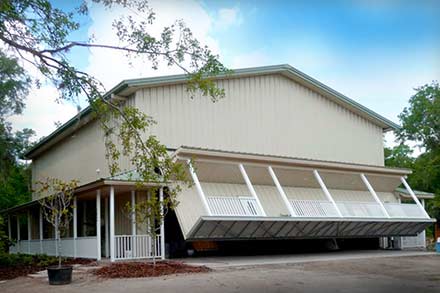
|
Classic Florida hangar home Schweiss wall/porch door is drawing national attention
Well, it's all of the above for 62-year-old Daniel Shaw, a plumbing contractor at Geneva, Fla. Who has given new meaning to the term "hangar home." The structure is 50' wide x 60' deep x 30' tall, all metal/ However, a 45' x 15' Schweiss hydraulic door sporting a wrap-around porch with decorator railing, table and chairs, a "walk through" door with stylish window, and veranda "roof" gets your attention. |

|
Schweiss doors open things up at the Renville County Fair
Schweiss Hydraulic and Bifold Doors recently installed four new hydraulic doors at the Renville County Fairgrounds located in Bird Island, MN. The Renville County Board approached Schweiss looking for a way to open up the event building located at the county's fairgrounds. The event building is used to host live bands, beer gardens and public auctions by Henslin Auction Services. Hydraulic doors seemed like the perfect solution to open up the building and allow easy access to the building for large groups of people. |
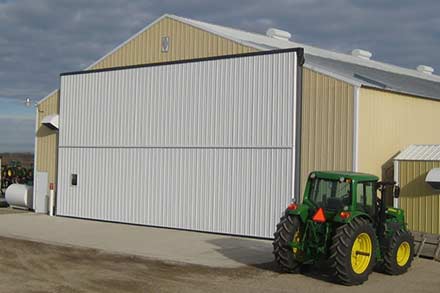
|
Minnesota Implement dealership spike in business calls for new facility liftstrap bifold doors
We're no longer just selling iron. Today we're selling precision farming products and that requires special training of both our personnel and our farm customers," says Paal Haug, general manager of Haug Implement with stores at Willmar and Litchfield |
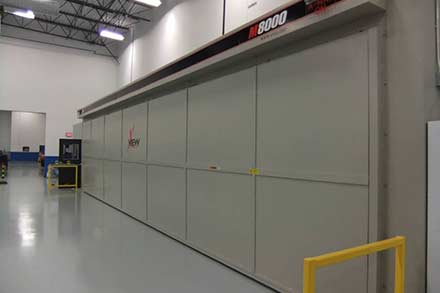
|
Radiation-shielded Bifold Door designed specially for industrial x-ray system firm
The creativity of customers continues to be a driving force for many manufacturers. Take for example North Star Imaging, Inc., a Rogers, Minnesota manufacturer of industrial x-ray systems which are enclosed by a radiation shielding cabinet and access door and used by manufacturing firms in the aerospace, military, automotive, medical device, electronics, even the genetic seed industry and many more. |
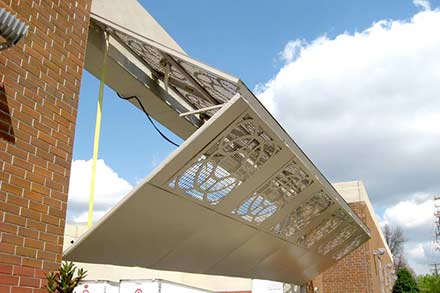
|
Stylish North Carolina Target store Bifold gates serve dual purposes
How do you make the loading dock area for your store secure, yet still easily accessible and stylish? This Target store in North Carolina found the answer with two 39' x 17' bifold gates for their loading area. Give us your idea and we will get you the door. |
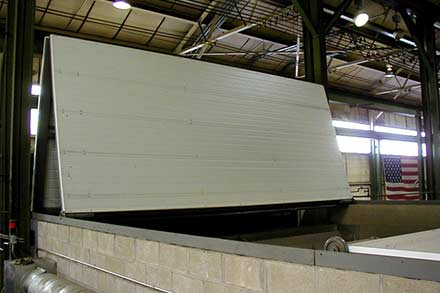
|
Unique Schweiss Bifold roof-door designed for East Coast sandblasting chamber
What looked like a near impossible situation without some totally new engineering design instead turned out to be a remarkable solution to an extreme challenge. The challenge? How to fit a "roof door" over a 20' by 30' sandblasting chamber used by SMS Millcraft, Oil City, PA. This firm specializes in refurbishing component parts for various Pennsylvania steel mills. |

|
Farm Air spraying operation relocates and builds new hangar with 76 ft. hydraulic door
It is rare that an Air Tractor dealership changes hands. It cant be done without an approval from Air Tractor, Inc. This requirement became all too apparent to Bill Taylor of Farm Air in Fairfield Illinois. Bill was starting to think about retiring from the business he formed in 1976. Shortly after forming Farm Air, Bill saw a need for Air Tractors in the Midwest, and approached Air Tractor about becoming a dealer. Over thirty successful years later, Bill decided it was time to sell Farm Air with its Air Tractor dealership intact. |
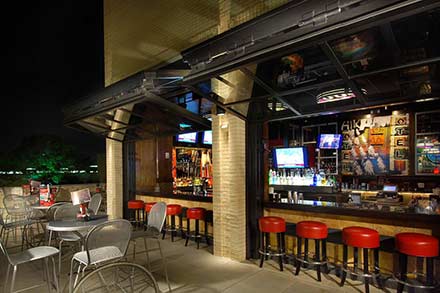
|
TGIF puts custom-made Schweiss Bifold glass doors on patio bar
This custom set of Schweiss Bifold Doors was the perfect solution to provide a unique dining experience for this restaurant's patio bar customers. |





